
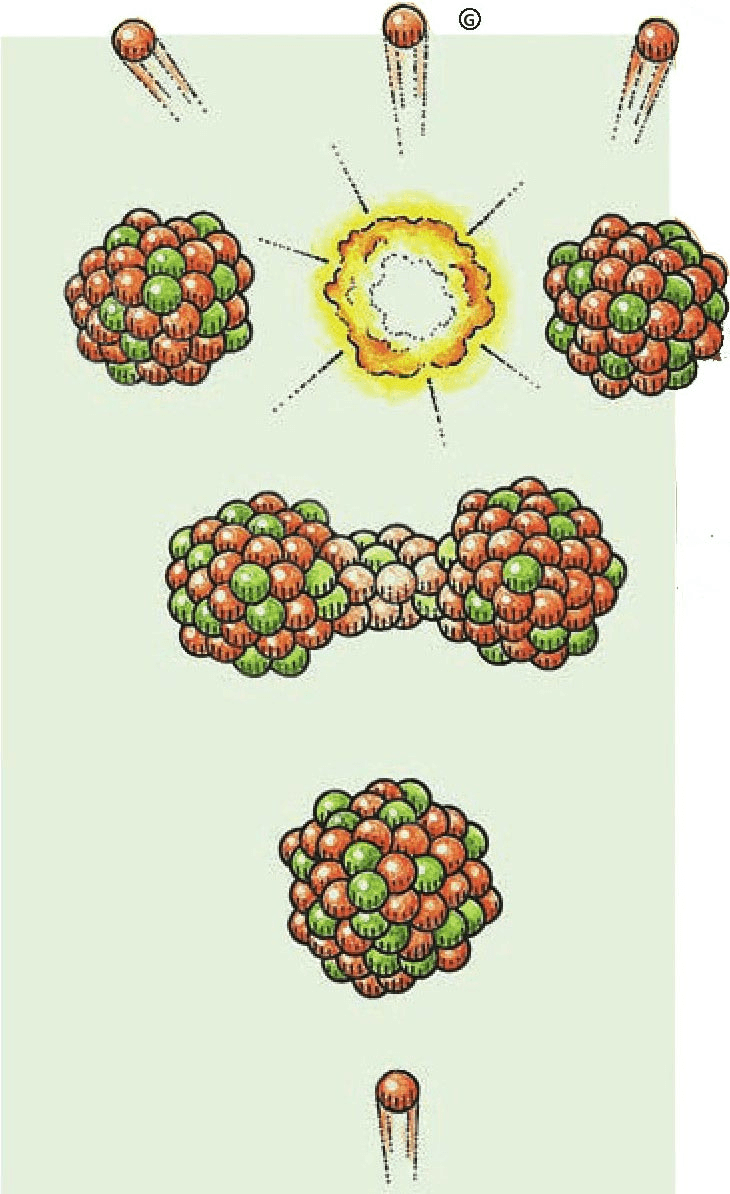
At the beginning of the 20th century, it was discovered that atoms are composed of electrons and a nucleus. Atoms are very small, and the nucleus is even smaller.
The atomic nucleus can be further divided into even smaller "tiny particles." These tiny particles are all "residents" of the atomic world, and there are many different kinds. Initially, only four types were discovered: electrons, photons, protons, and neutrons. Later, positrons, neutrinos, mesons, hyperons, and variableons were discovered, collectively known as "elementary particles." It is estimated that about 400 types of elementary particles have been discovered so far, and more are being discovered continuously.
Among the family of elementary particles, protons and neutrons are relatively large, with diameters of approximately 1.6 × 10⁻¹⁵ meters and masses of approximately 1.67 × 10⁻²⁷ kilograms. Other elementary particles are much smaller. For example, the total mass of 1836 electrons is only equivalent to that of a proton; and a neutrino or antineutrino has only 1/10,000th the mass of an electron. Furthermore, protons and neutrons are composed of even more fundamental building blocks—quarks and gluons.
Interestingly, the rest mass of a photon is zero.
The most massive particle is the hyperon, which is 340 times the mass of a proton, hence the name "hyperon". However, hyperons have a very short lifespan, typically only lasting one ten-billionth of a second.
The origin of the name meson is also interesting; it refers to the fact that its mass is between that of an electron and a proton. Mesons have many "siblings," some positively charged, some negatively charged, and some uncharged.
It has also been discovered that some of these fundamental particles can transform into one another. Take electrons and positrons, for example; they are the same size and mass, carrying the same amount of electric charge—only the charges are opposite in sign. When they meet, they can transform into two photons. When an antiproton and a proton approach each other, both lose their charge and become neutral antineutrons. In March 1960, Chinese physicist Professor Wang Ganchang reported his discovery of a new fundamental particle—the antisigma hyperon—at the Ninth International Conference on High Energy Physics. This hyperon can decay into an antineutron and a positively charged meson. This means that these tiny "residents" of the atomic world are not isolated and static, but interconnected and constantly changing.
Are elementary particles the most "basic" particles in the material world?
Humanity's ability to conquer nature is still insufficient. The highest achievements of modern science and culture, in the context of the entire history of human development, are still in their infancy. Some particles currently considered "elementary particles" may be discovered in the future not to be "elementary" at all, but rather composed of other even smaller "elementary particles"—this is quite possible.
Although the "inhabitants" of the atomic world are so tiny and elusive, many scientists are constantly exploring and striving to uncover the mysteries of the microscopic world.