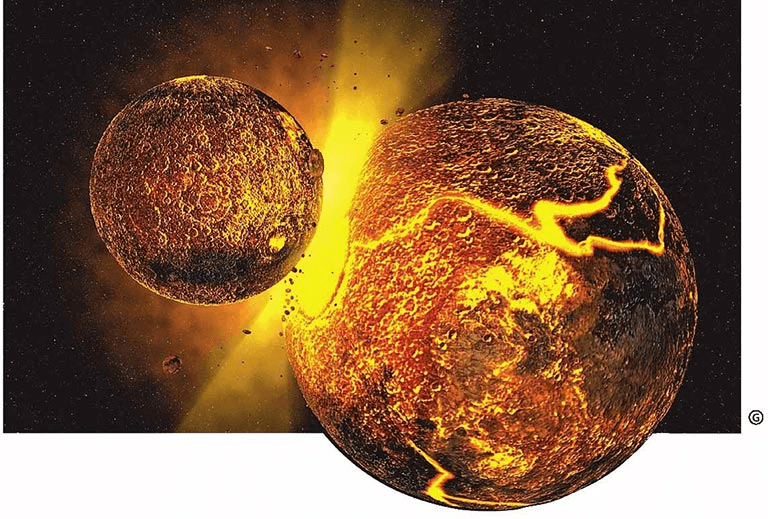
Is the earth the sun's "child" or "younger brother"? Viewed from space, the earth is a beautiful blue planet. We can see blue oceans and green land. This is the only home for humans and other living things. Over hundreds of millions of years, the ancient sea has dried up into deserts, the ocean floor has risen into mountains, and countless creatures have flourished and flourished. How did the earth come into being? What is the relationship between the earth and the sun? Does the earth have brothers and sisters? What did the earth look like? We have countless curious questions about the origin of the earth. A primitive planet collided with the primitive earth The famous German philosopher Kant proposed the "nebula hypothesis" of the origin of the solar system in 1755, which is now supported by more and more scientific evidence. The "Nebula Hypothesis" holds that about 5 billion years ago, the current solar system was still a vast nebula filled with cosmic dust and thin gas, the main components being hydrogen and helium. About 4.57 billion years ago, a supernova exploded near the solar system, producing huge energy that formed various elements with greater mass than hydrogen and helium, including a large number of radioactive elements. Nebula material quickly contracts, gathers and rotates. Due to the high density and temperature at the center of the nebula, hydrogen nuclear fusion began to occur, releasing huge heat energy and forming a dazzling sun. At the same time, material in the outer reaches of the solar system will also gather, first forming countless primitive planetesimals with a diameter of about 1,000 meters. They collide with each other and eventually gather into some primitive planets the size of the moon. Several primitive planets further collided to form the primitive Earth. Ten to 30 million years after the supernova explosion, a primitive planet between the size of Mars and the Earth hit the primitive Earth. Part of the primitive planet joined the Earth, and part of the primitive planet entered orbit around the Earth to form the moon. At this time, the earth completed its main growth process and had a structure basically similar to that of modern earth. From this point of view, the earth is regarded as the sun's "follower brother". As for the moon, it is like a "little follower" of the earth.
Is the earth the sun's "child" or "younger brother"?
This paper focuses on the relationship between the earth and the sun, and introduces the nebula hypothesis of the origin of the solar system put forward by the German philosopher Kant in 1755. It explains that the nebula of the solar system formed the sun through processes such as supernova explosion 5 billion years ago, and the collision formation mechanism between the earth and the moon. The final conclusion is that the earth is the sun's "follower" and the moon is the earth's "follower".