
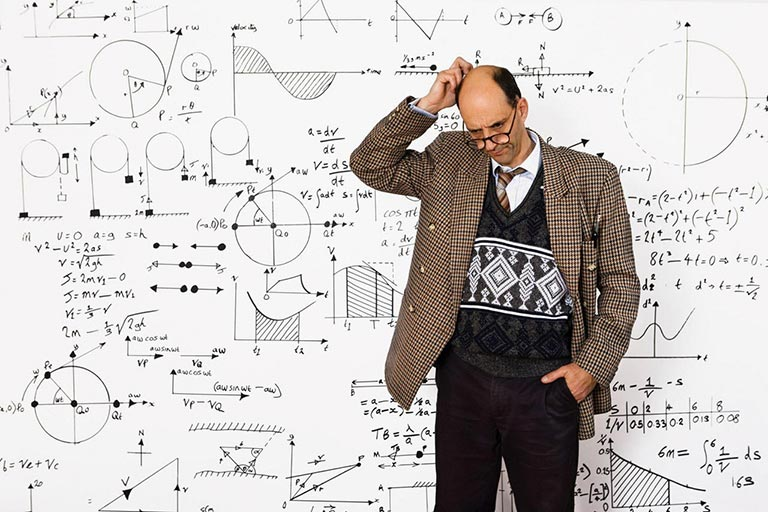
The answer is absolutely not. To make a substantial contribution to mathematics, you need to put in hard work, become familiar with your own research field, understand other fields, master the tools, ask questions, engage in dialogue with other mathematicians, and actively think about "macro-level problems." Admittedly, a certain level of intelligence, patience, and maturity are also necessary, but you don't need any magical "genius genes," profound insights, unexpected solutions, or any kind of supernatural ability.
Many people envision a solitary (and perhaps even eccentric) genius: someone who doesn't read literature, doesn't think conventionally, and relies entirely on some inexplicable inspiration (perhaps after some struggle) to provide original solutions to problems that baffle experts. This image is captivating and romantic, but also quite absurd, at least in the modern mathematical world. Of course, mathematicians do produce wondrous, profound, and astonishing results and insights, but these are the accumulation of diligent research, often backed by years, decades, or even centuries of continuous work—the collective progress of many excellent and great mathematicians. The elevation of one's thinking is indeed extraordinary, sometimes even unexpected, but it remains a continuation of the work of predecessors, not the creation of something entirely new. The contributions of the British mathematician Wiles to Fermat's Last Theorem and the research of the Russian mathematician Perelman on the Poincaré conjecture are examples of this.
When I was a student, I also had a romanticized view of mathematics, believing it was primarily driven by the mysterious inspiration of a very few "geniuses." However, in contemporary mathematical research, as long as one works diligently, follows intuition, reads literature, and has a bit of luck, progress will naturally follow over time. Now I think the latter is far more ideal than the former. Frankly, that kind of "genius worship" brings many problems because no one can continuously generate these (extremely rare) inspirations. (If someone claims to have this ability, I strongly suggest you be skeptical.) But some people insist on taking on this impossible task, and end up going astray under pressure. Some become obsessed with "major problems" or "major theories"; some are overly reliant on their research and methods, losing the necessary critical thinking; and some completely lose confidence and stop working in mathematics altogether. Furthermore, attributing success to innate talent (which is beyond one's control) rather than hard work, planning, and education (which are controllable) brings other problems as well.
Of course, even if we set aside the notion of "genius," history has indeed seen mathematicians who were quicker-witted, more experienced, more knowledgeable, more efficient, more cautious, or more creative than others. However, this doesn't mean that only "top" mathematicians should study mathematics. This viewpoint mistakenly equates absolute advantage with relative advantage, a common error. Mathematics contains numerous interesting areas and problems, and delving into them all is far beyond the capacity of even "top" mathematicians. Moreover, sometimes the tools and ideas at your disposal will reveal things that other excellent mathematicians have overlooked, especially considering that even great mathematicians have areas where they are less proficient. In short, as long as you are educated, interested, and have some talent, there will always be a few areas in mathematics where you can utilize your abilities and make practical and useful contributions. These may not be the most glamorous parts of mathematics, but this is a normal phenomenon; often, seemingly mundane fundamental problems are more important than any fancy application. Furthermore, before you can tackle the famous problems in a field, you should start with the less glamorous parts of that field; just look at the early achievements of any great mathematician today and you will understand what this means.
For some, abundant talent can actually hinder their long-term development in mathematics. For example, if the answers come too easily, they may not expend the effort to work hard, ask "foolish" questions, or broaden their knowledge. Over time, their abilities will stagnate. In addition, once they become accustomed to easy success, they may not develop the patience required to solve truly difficult problems.
Talent is certainly important, but how to cultivate and develop talent is even more important.