
Why do fractions have to be divided first?
In fractional multiplication, the multiplication of two fractions equals the multiplication of the numerator and denominator respectively. However, in addition, the numerator and denominator cannot be added separately. Instead, the denominator must be first added to the same denominator, and then the denominator remains unchanged and the numerator is added. Why is this? To answer this question, we must first clarify the meaning of fractions and their additions.
A (positive) fraction is a number, which represents dividing an overall object into several parts (this part is called the denominator), and extracting the proportion of several parts (this part is called the numerator) to the overall. For example, if you divide a watermelon into 5 parts equally, and take out 3 of them, the proportion of the total will be 3/5. Sometimes, the number of shares taken out (numerator) exceeds the average number of shares taken out by a whole (denominator), which means that if the amount taken out exceeds a whole, the value is greater than 1, which is a false fraction.
There are many different ways to express the same proportion in terms of fractions. For example, dividing a watermelon into 5 parts and taking out 3 of them is the same as dividing the watermelon into 10 parts and taking out 6 of them. In other words, a fraction actually has a "family" where there are infinite members, and any one of them can represent it.
So what does the addition of two fractions mean? Since each score represents the proportion of the extracted part to the whole, and two scores represent that two parts are extracted from the whole, the proportion of the two parts taken together to the whole is the sum of the two scores.
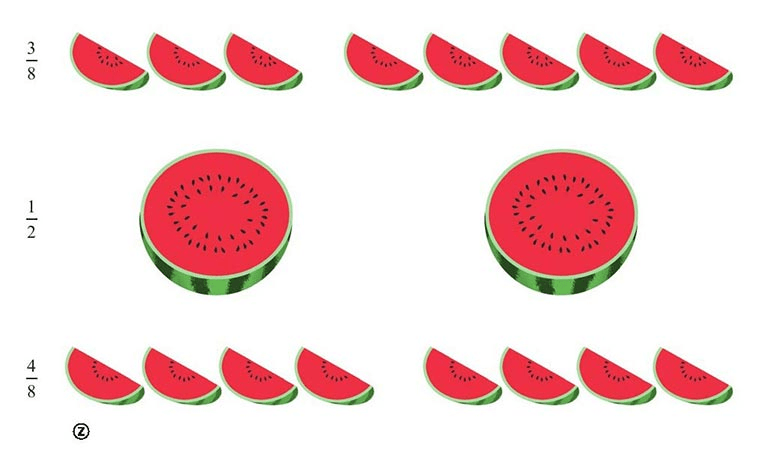
For example, calculating 3/8 + 4/8 is equivalent to dividing two watermelons of the same size into 8 equal portions, taking 3 portions from one watermelon, and 4 portions from the other watermelon. The total amount required to be taken out (the sum of the two) is the proportion of one watermelon. Since the total amount taken out is equivalent to taking 7 (3+4) portions from a watermelon, the sum is 7/8, which is added to the denominator fraction, the denominator remains unchanged, and the numerators are added.
If you want to calculate 1/2 + 3/8, you cannot simply add the two fractions. This is equivalent to the second watermelon being divided into 2 equally, and one part is taken out of it. However, this is the same in terms of proportion as dividing it into 8 parts and taking out 4 parts just now, so it can be transformed into the situation where the second watermelon is also divided into 8 parts and taking out 4 parts. This is the case where fractions with different denominators are added, and they must be transformed into the same division, that is, the case where the denominator is the same. In other words, when two fractions with different denominator are added, we must select the two members with the same denominator from each of the two fraction "families" to participate in the operation. This process is called general division. For example, calculating 1/2 + 3/8, we must select two members with the same denominator 4/8 and 3/8 in the 1/2 family and 3/8 family respectively to participate in the operation, and the result is 7/8.