
In middle school textbooks, in addition to the commonly used logarithm lg x, there is also the natural logarithm ln x, which represents the logarithm with the base e, where e = 2.718281828… Why is the logarithm with the base e called the natural logarithm? In modern textbooks, the logarithm function is defined as the inverse function of the exponential function, but this was not the case in history. The logarithm was first proposed by Scottish mathematician John Napier in 1614. Napier's invented logarithm could convert the multiplication operation of two numbers into an addition operation, greatly simplifying the complex calculation problems encountered in scientific fields such as astronomy and navigation at that time. A function satisfying the following properties is called a logarithm function: y = f (x) (x > 0); f (x1x2) = f (x1) + f (x2); f (1) = 0.
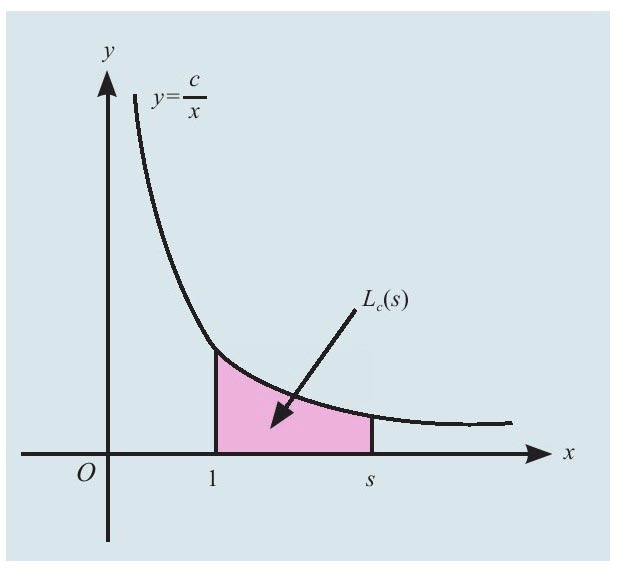
In the process of seeking a logarithm function, people discovered the following fact: for any given positive constant c, and considering the hyperbola y = c/x in the first quadrant. Let s be any positive number, and the area of the shaded part is denoted as Lc (s). We agree that when s = 1, this area is 0; when s > 1, its area is positive; and when s < 1, its area is negative. Under this convention, the function Lc (s) is a logarithm function.
Now, we denote the logarithm function corresponding to c = 1 as y = L (s). At that time, some people called L (s) the natural logarithm, because it was the simplest logarithm function among the logarithm functions Lc (s). For ease of calculation, it could also be used to represent other logarithm functions. In fact, as early as the second year after Napier proposed the logarithm, someone used it to compile a logarithm table and appended it to Napier's book. But at that time, people did not know what the number e was, nor did they have the concept of the "base of the logarithm function".
In the 18th century, Euler linked the logarithm function with the exponential function and regarded the logarithm function as the inverse function of the exponential function. At this time, the concept of the base of the logarithm function was introduced. Euler also found that the number called the base of the natural logarithm was exactly the number e.