
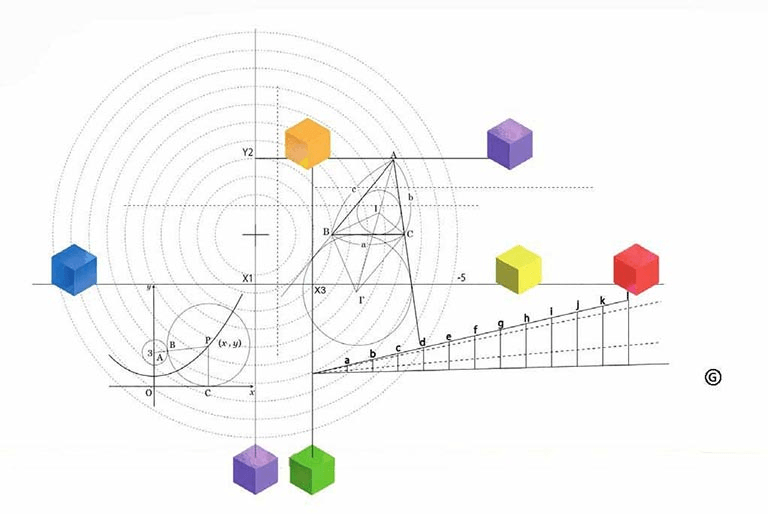
For most people, mathematics is likely the subject they study most extensively throughout their lives: from elementary school to secondary school, from secondary school to university, and even into the postgraduate phase, the study of mathematics is a constant presence. If one views this learning merely as a means to comply with school and teacher regulations—solely to pass exams, achieve high grades, or acquire a certain amount of mathematical knowledge—one will inevitably adopt a passive and perfunctory attitude toward the subject. Consequently, the effectiveness of one's learning will undoubtedly suffer significantly. So, why should we study mathematics, and why is it important to master it? We can provide a direct answer to these two questions by examining, on the one hand, the inherent importance of mathematics itself, and on the other, the vital role that mastering mathematics plays in both talent development and personal growth. As is widely known, mathematics is the science dedicated to the study of quantitative relationships and spatial forms within the real world. The role and status of mathematics can be summarized in the following key aspects:
First, mathematics serves as a scientific language. Galileo once remarked: "The book of the universe is written in the language of mathematics... unless you first understand its language... this book cannot be read." This scientific language of mathematics is characterized by its extreme precision—a defining feature of the discipline. Furthermore, this language is universally understood across the globe. Operations such as addition, subtraction, multiplication, and division; exponentiation and root extraction; logarithms and indices; differentiation and integration; and constants like π, e, and i—while these mathematical terms and symbols may have originated in diverse forms with distinct nuances, they have long since been standardized into a fixed, unified system that is recognized and utilized worldwide. Second, mathematics acts as a powerful tool. It is an indisputable fact that mathematics plays a vital role—at all times and in all places—within people's daily lives and productive activities. Today, serving as a crucial instrument in the construction of a modern society, mathematics plays an even more critical—and at times, decisive—role across a multitude of key fields.
Third, mathematics constitutes a common foundation. Whether in the natural sciences and engineering technologies, or in economics, management science, and even the humanities and social sciences, mathematics has become an indispensable foundation. It enables us to analyze problems with precision and in quantitative terms, thereby allowing us to derive well-substantiated insights into underlying principles and patterns. Indeed, the trend toward "mathematization"—the increasing application of mathematical methods—is becoming evident across many scientific disciplines (particularly within the natural sciences); in some areas, its initial signs have already emerged, while in others, it is poised to break through at any moment.
Fourth, mathematics is a fundamental science in its own right. By abstracting away the specific physical forms and properties of matter, mathematics investigates the real world purely through the lens of quantitative relationships and spatial forms. Mathematics is not merely a branch of the natural sciences; it does not belong to the same hierarchical level as disciplines such as physics, chemistry, astronomy, earth sciences, and biology. Rather, mathematics bears a resemblance to philosophy—the study of the laws of thought—in that it possesses characteristics that transcend specific sciences and are universally applicable. Contemporary mathematical science now constitutes a vast scientific system, encompassing numerous sub-disciplines—including both pure and applied mathematics—as well as a multitude of emerging interdisciplinary fields. Fifth, mathematics is a critical technology. The fusion of mathematical concepts and methodologies with computational techniques has given rise to a distinct form of technology—specifically, a critical and implementable technology—known as "mathematical technology." Fundamentally, this involves the materialization of mathematical content into computer software or hardware, thereby becoming an integral and pivotal component of technology itself, capable of being directly transformed into productive forces. The proposition that "high technology is, in essence, a form of mathematical technology" is a view that is now gaining acceptance among an ever-growing number of people.
Finally, mathematics represents an advanced form of culture. Mathematics serves as a fundamental cornerstone of human civilization. Its genesis and evolution have paralleled the trajectory of human civilization, consistently playing a vital catalytic role within that process and occupying a position of paramount importance. Today, humanity enjoys the manifold benefits of mathematical culture to the fullest extent; yet, often taking these blessings for granted—or remaining entirely oblivious to them—mathematics has long remained in the status of an "unsung hero." Nevertheless, as the ancients observed: "Had Heaven not given birth to Confucius, the ages would have remained in perpetual night." Similarly, were it not for mathematics—and the progress it has fostered—humanity might well remain mired in ignorance and backwardness, living lives akin to an endless night. Throughout history, as humanity has striven to comprehend and transform the world, mathematics—serving as both a precise language and a potent instrument—has consistently played an indispensable role. Particularly in the modern era, mathematics has assumed a pivotal function across numerous domains: acting as a crucial instrument for economic development, a foundational bedrock for all scientific disciplines, and a vital pillar of human civilization. Mathematical technology has emerged as a defining hallmark and an indispensable constituent of high technology; indeed, the influence and utility of mathematics may be described as ubiquitous, and its profound importance is now being acknowledged by an increasingly broad audience. Consequently, it is only fitting—and indeed, entirely logical—that mathematics ranks among the most critical compulsory courses, not only within primary and secondary education but also across a great many departments and disciplines within the university curriculum.