
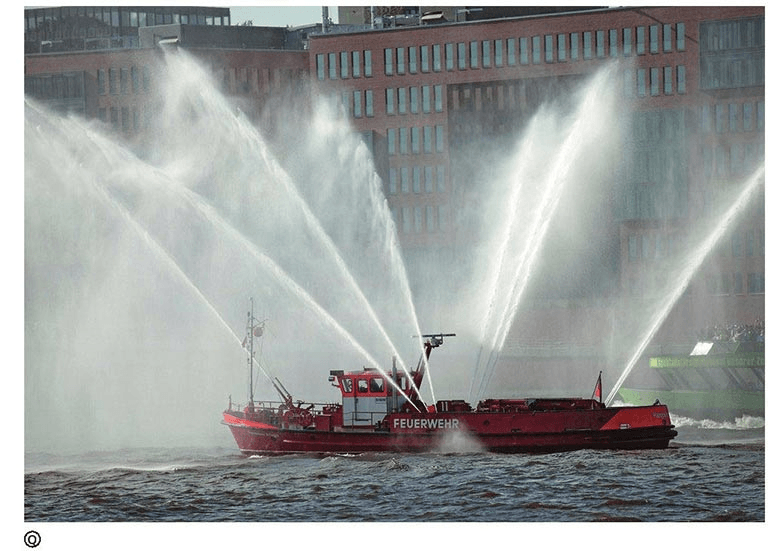
Whenever a fire breaks out, fire brigades respond quickly to the scene. To extinguish the fire rapidly, firefighters often use multiple fire hoses to form a network of water, quickly controlling the spread of the flames. The water jets from these hoses are rapid and high, sometimes reaching hundreds of meters. Why is this? A closer look reveals that the nozzle of a fire hose is relatively small. Why can a small nozzle produce a high-speed water jet? This is because designers utilize principles of fluid mechanics. When a certain flow rate of fluid passes through a pipe, the fluid velocity is inversely proportional to the pipe diameter; a larger pipe diameter results in a lower velocity, and vice versa. Therefore, to achieve a higher jet velocity, the nozzle diameter of a fire hose is relatively small. The higher the velocity of the water jet at the outlet, the greater its kinetic energy, and thus the higher the water jet is propelled. In modern metropolises with their towering buildings, fires can cause devastating damage. Therefore, modern fire truck ladders can reach heights exceeding 100 meters, and combined with the water jet's reach of over 100 meters, they can directly extinguish fires in buildings dozens of stories high.
Water hoses are essential weapons for firefighters in extinguishing fires. Besides firefighting, water hoses can also play a crucial role in the smoke-filled battlefield. During World War II, an American destroyer was anchored and awaiting orders. Suddenly, an enemy mine drifted towards the ship with the tide. When the entire crew noticed it, they were stunned. There wasn't enough time to weigh anchor and set sail; starting the engines to move the mine away might cause it to drift even faster with the propellers; detonating it with gunfire would bring it too close to the ship. Just when tragedy seemed inevitable, a sailor suddenly shouted, "Get the water cannons!" Everyone immediately understood. They sprayed water into the sea between the ship and the mine, using the current to propel the mine further away, and then detonated it with the ship's guns. The high-speed water cannons saved the lives of everyone on board.
On the eve of the Fourth Arab-Israeli War, the Suez Canal was still under Israeli control. How to breach this formidable barrier became a major headache for Egyptian high-ranking officers. A junior officer devised a method of using high-pressure water cannons to breach the canal, and an experiment proved remarkably effective. After the battle commenced, Egyptian engineering units equipped with specially designed high-pressure water cannons quickly breached the canal, opening 60 7-meter-wide channels on the west bank within two hours. This allowed a nearly 80,000-strong assault force to cross the canal within hours and seize control of key locations on the Sinai Peninsula. In this war, the Egyptian army decisively broke through the Israeli canal defenses, which had been forged over many years. One is for defense, the other for offense; the use of water guns to create miracles in warfare is truly remarkable and thought-provoking. Under specific conditions, water guns not only possess the function of ordinary weapons in eliminating the enemy and preserving oneself, but also achieve extraordinary results.