
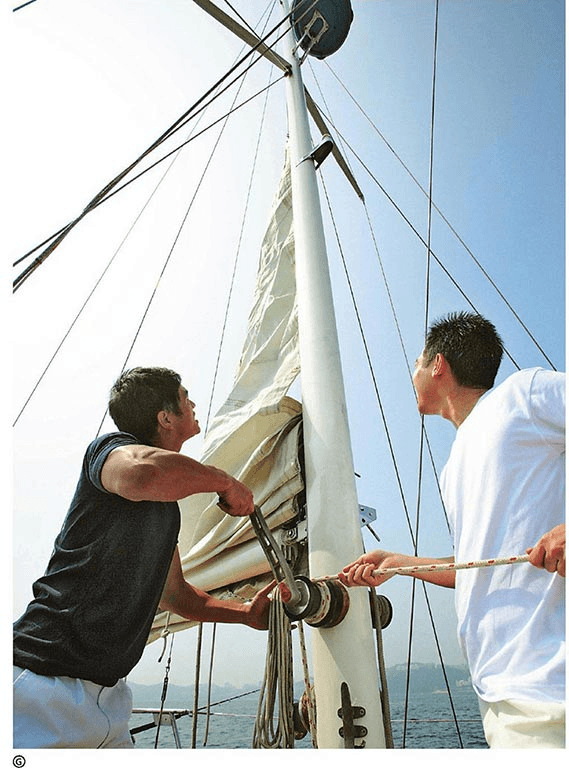
Sailing ships are propelled by the thrust of the wind, so it is hard for the average person to imagine that a sailboat can sail against the wind. However, experienced sailors tell us that it is possible, and they usually call it "riding the wind".
When sailing with the wind, it is the force of the wind acting on the sail that propels the sailboat forward. So, what is the force that propels the sailboat forward when sailing against the wind? The answer is still the force of the wind acting on the sail! In fact, no matter which way the wind blows, it always generates a force perpendicular to the sail, and it is this force that propels the sailboat forward. Let's assume there's a wind blowing against the sail from directly in front, and adjust the sail to an angle between the wind and the hull. The force of the wind on the sail can then be decomposed into two mutually perpendicular components. One component blows along the sail, having almost no effect on the sailboat, while the other component acts perpendicularly to the sail. This force perpendicular to the sail can be further decomposed into two mutually perpendicular components: one perpendicular to the hull, which can be counteracted by the longitudinal baffles installed at the bottom of the boat, and the other component along the hull direction, which propels the boat forward. In this case, if the destination is directly opposite the wind, although the boat moves forward, its bow deviates from its course. Don't worry, just keep adjusting the direction of the hull and sails as you go, so that the sailboat's path is zigzagging.