
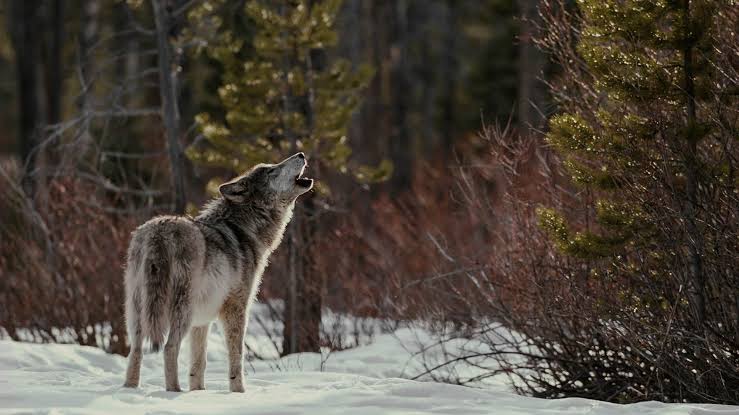
Speaking of wolves, the first thing we think of is the wolf pack chasing prey in groups, as well as the howling of wolves facing the sky under the moon, which sounds very scary. So why do wolves like to howl at night?
In classification, wolves belong to the genus Canid, the carnivorous order of mammals. They are subdivided into gray wolves, red wolves (North American red wolves), jackals, coyotes (coyotes), etc., and some close relatives are also often called "wolves". When we usually say wolf, we mean gray wolves. Except for a few islands, gray wolves were widely distributed in the northern hemisphere, including Europe, Asia and North America, and were also widely distributed in various provinces and cities in China. In sparsely populated areas, gray wolves still have a large living space.
If fought alone, wolves are not the most powerful carnivores. The reason why they are so powerful among carnivores is because of their ability to fight in groups. Members of the wolf pack work together to defend the enemy, cooperate to raise their young, and divide their division of labor to hunt food, thus greatly improving their survival ability. However, all members of the wolf pack are not completely equal. They have strict social hierarchies and have derived a series of communication methods, such as showing weakness, attacking, nursing, playing, etc., and of course, voice communication is also indispensable.
Wolves are nocturnal animals that encounter communication problems when they begin to act collectively at night. In this case, only sound is the most convenient and effective means of communication, so we heard the terrible "ghost cries and howls". Howls have multiple functions. A lost lone wolf will howl and expect to return to the team, a male wolf in heat will howl and call on a female wolf, and a group of angry wolves will declare their sovereignty through howling... Interestingly, each wolf has its own unique voice and its own favorite range. They don't seem to like making the same sound as their companions. When the same sound occurs occasionally, they become agitated until they return to dissonance. This is more or less related to the original intention of the "chorus". They always hope to tell other families about their existence with noisy howls, and the ever-changing tone seems to be creating greater momentum, so that other wolves who covet the territory feel the strength and prosperity of the territory's owner, thereby dispelling the idea of harassment. However, sometimes these "chorus" seem to be just having fun when they are bored.
Now, zoologists looking for wolf packs have also learned this trick-learning to howl. If there are wolves nearby and zoologists make wolf howls, they will usually respond. In this way, zoologists can follow the sound and sneak close to the wolf pack for observation and research. However, the prerequisite is that you must learn like it.