
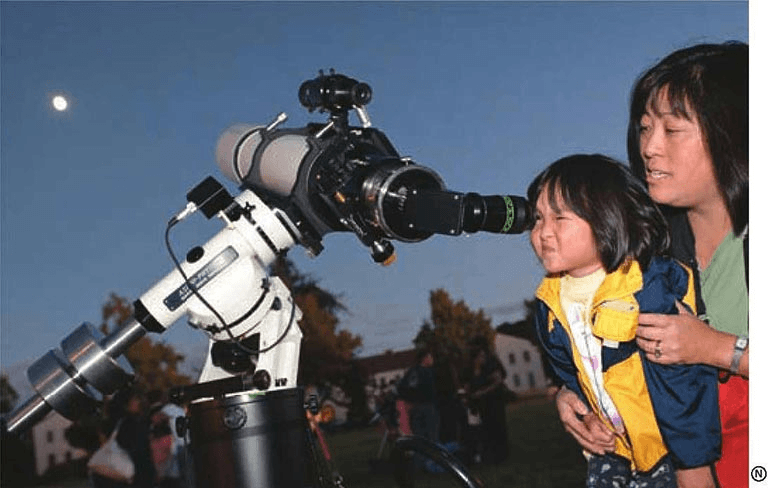
Not only professional large telescopes can conduct astronomical observations. Some larger and brighter celestial bodies in the sky can be appreciated using amateur astronomical telescopes. In fact, the professional telescopes of the Galileo and Newton era were not as good as today's mid-to-high amateur telescopes. If you point the telescope at the moon, you can observe that the surface of the moon is covered with craters of large and small sizes; aim at Saturn, the rings around Saturn will be very interesting; point at the Milky Way, the ethereal Tianhe River turns out to be composed of countless stars. Using higher-quality telescopes, you can also observe the profit and loss phenomenon of Venus, the stripes and great red spots on the surface of Jupiter, and even the polar cap of Mars; in mountainous areas with better observation environments, you can also find mysterious and beautiful nebulae and galaxies.
So, how should we choose our own telescope? First of all, we must clarify the characteristics of the observation target: when observing bright and detail-rich celestial bodies (such as the Moon, Saturn, and Jupiter), a telescope with a long objective lens focal length is needed, which is conducive to obtaining a large magnification; when observing dim distant nebulae and galaxies When such targets, a telescope with a short objective lens focal length is needed to obtain a larger field of view and a higher contrast. Secondly, we must consider the aperture of the telescope: the aperture determines the resolution of the telescope. The larger the aperture, the clearer the image. However, the larger the aperture, the higher the price and inconvenient to carry around. You need to find a balance between the aperture and portability that suits you. In addition, the price of telescopes of the same optical form and aperture may vary greatly, which is mainly caused by different manufacturing precision. The observation effect of small-aperture telescopes with higher manufacturing precision often exceeds that of crudely manufactured large-aperture telescopes. Therefore, a telescope with a larger aperture is the most appropriate choice on the premise of having the appropriate focal length, high optical quality and being economically affordable.
However, many interesting celestial bodies are still difficult to see clearly with the naked eye through a telescope. At this time, we need to use a SLR camera to replace the naked eye to observe faint celestial bodies deep in the universe in order to give full play to the greater effectiveness of amateur astronomical telescopes.