
Before the invention of telescopes, the main job of astronomers was to measure time and observe the direction of celestial bodies.
In China, the oldest astronomical instrument is the Guimiao introduced in the early Western Zhou Dynasty. It is divided into two parts: Gui and Table. The Gui is placed horizontally along the north-south direction, while the watch is erected at the southern end of the Gui and extends towards the top of the head. The height of the watch is generally "eight feet" and there is a round hole at the top. At noon, sunlight enters the round hole and leaves a hole shadow on the surface of the gui. During the winter solstice, the distance between the hole shadow on the surface and the bottom of the surface is the longest; during the summer solstice, the distance is the shortest. In ancient China, the time interval from the winter solstice when the hole shadow on the gui surface was the longest to the winter solstice of the following year was designated as a year of regression.
The gnomon table is mainly used to measure time, while the instrument commonly used to measure the coordinate position of celestial bodies in ancient China was the armillary sphere. It consists of a peep tube aimed at the celestial body to be measured, a reading ring reflecting various coordinate systems, a supporting structure and rotating parts. When the peephole is aimed at the celestial body to be measured, several coordinates of the celestial body can be read out from multiple sets of rings. During the Yuanyou period of the Northern Song Dynasty, Su Song and Han Gonglian made the Yuanyou armillary sphere. The Yuanyou armillary sphere was later installed in the water transport instrument Elephant Taichung built by the two of them in the seventh year of Yuanyou (1092). The platform is 12 meters high and 7 meters wide, and is divided into three sections: upper, middle and lower. The upper partition is placed on the Yuanyou armillary sphere, and the middle partition is placed on the celestial sphere (which can be used to demonstrate celestial phenomena, similar to today's celestial sphere); the front of the lower partition is a five-story wooden pavilion where puppets enter and exit to tell the time, and the rear is a huge pivot wheel filled with 36 water buckets, which serves as a power device. This power device can not only drive the puppets in the five-story wooden pavilion to enter and exit the time, but also make the peeping tube of the Yuanyou Armillary Sphere and the celestial elephant turn an angle every few minutes, thus playing the role of tracking the motion of celestial bodies. The roof of the Yuanyou armillary sphere can be opened, creating the first of its kind for the active roof of today's astronomical observatory; and its peeping tube can intermittently track celestial bodies, which is the ancestor of modern telescope clocks. It can be seen how smart the developers of the water transport instrument and elephant platform are!
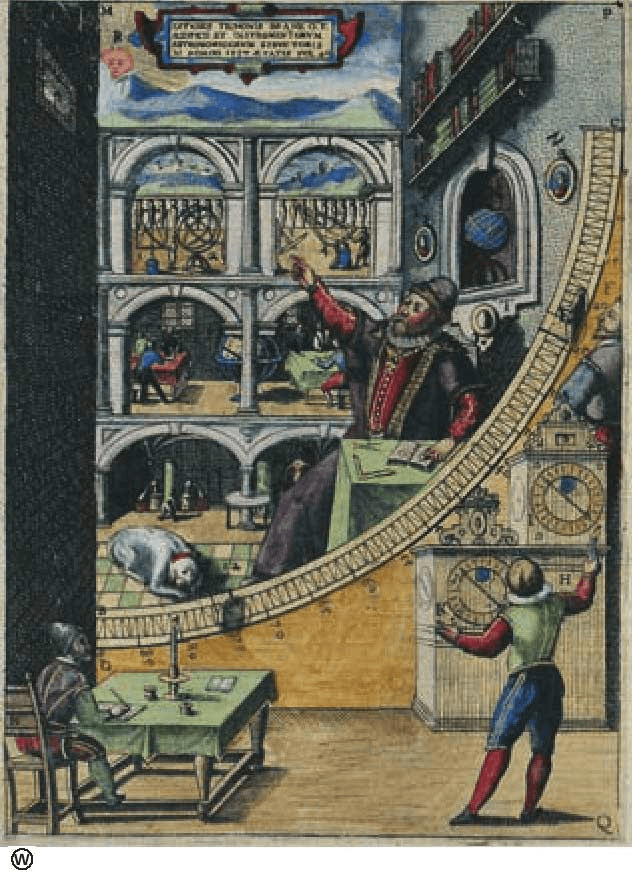
In the late 16th century, Danish astronomer Tycho established an observatory on the island of Wen and installed more than a dozen classical astronomical instruments that he carefully designed. One of the most famous is a unique wall quadrant. It is installed on a wall in the north-south direction. The main component is a 90-degree copper arc with a radius of 1.8 meters and fine scales. There is a sight on it, which allows observers to determine the position of stars seen in the upper rectangular hole on the south wall. This wall quadrant can measure the altitude of the celestial body when it passes the meridian circle, that is, the inclination of the celestial body's direction to the ground plane. The classical astronomical instruments developed by Tycho have a fine structure and high accuracy in astronomical observations. Later, German astronomer Kepler used observations left by Tycho to arrive at the famous laws of planetary motion.