
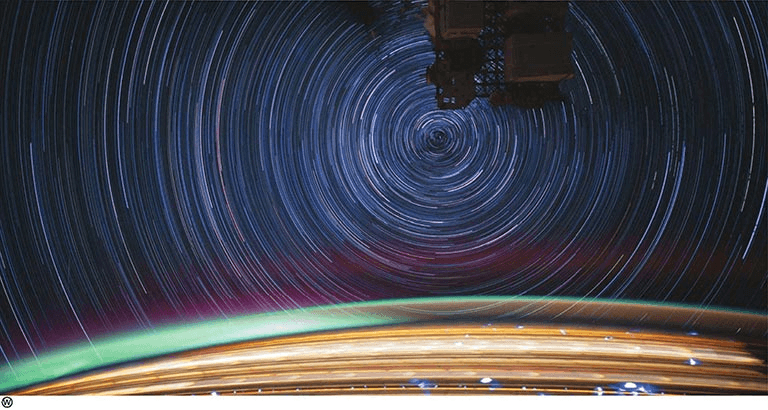
From any location on Earth, one can only see half of the night sky; the other half lies below the horizon. At the North and South Poles, the Earth's axis of rotation passes overhead, so the stars remain the same regardless of Earth's rotation; those below the horizon do not rise. However, at average latitudes, the night sky appears to change regularly with the seasons.
The changing constellations in the sky throughout the seasons are related to Earth's revolution around the sun. Stars other than the sun are very far away from Earth, while Earth is relatively close to the sun. Therefore, as Earth revolves around the sun, it appears from Earth that the sun is moving among the relatively stationary stars, completing a cycle every year; this is called the "solar apparent motion." Because Earth's atmospheric molecules scatter sunlight, we cannot see the half of the sky obscured by the sun's brilliance during the day, but only the other half in the opposite direction at night. Thus, with the sun's apparent motion, we see different constellations in turn. In spring, the sun is not far from Pegasus, and at midnight, Leo, in the opposite direction, hangs high overhead; in summer, the sun moves to near Orion, and Scorpius is visible at midnight; in autumn, the sun is in Leo, and Pegasus becomes the main constellation in the midnight sky; in winter, the sun moves to Scorpius, so Orion is the dominant constellation in the night sky. This is the changing of the constellations throughout the seasons.
Of course, the changing of the night sky isn't a sudden change of seasons, but rather a continuous process every night. Because the sun's apparent annual motion is 360°, which translates to about 1° of movement along the ecliptic each day, and the stars rise in the east and set in the west due to the Earth's rotation, it takes about 4 minutes for the same star to complete this 1° movement. Therefore, the same star rises 4 minutes earlier each day, 2 hours earlier each month, and 24 hours earlier each year, eventually returning to its original time. The stars shift and the constellations turn, year after year, the night sky always moving in this regular and continuous cycle.