
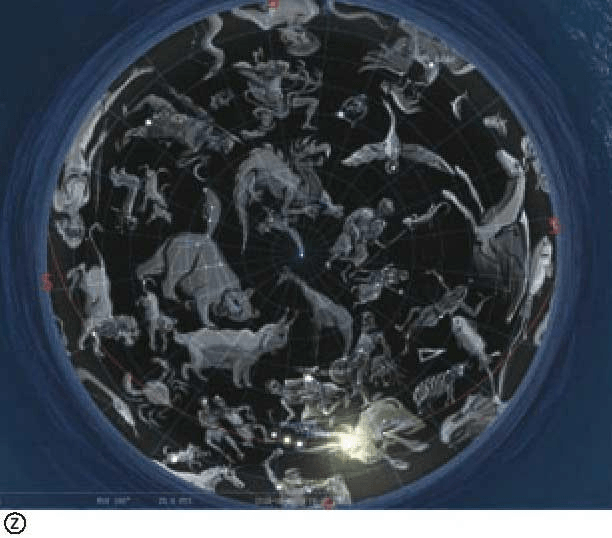
On a clear night, the sky is filled with countless stars. Ancient humans, through long-term observation, discovered that the patterns formed by the stars were constant, with only a few bright stars (planetary) moving among them. To distinguish and name these constant stars, people grouped them and gave them specific names. Different cultures used different methods of grouping and named them. The modern internationally accepted constellation system can be traced back to ancient Babylon. Ancient Babylon had the earliest constellation names as early as 5000 years ago. In the 13th century BC, 12 constellations on the zodiac were identified, called the "Zodiac," meaning 12 houses in the sun's annual journey. Later, this was gradually expanded, and more constellations were named. In the 2nd century AD, the ancient Greek astronomer Ptolemy, based on the knowledge of his predecessors, compiled a table containing 48 constellations. The great geographical discoveries of Europe in the 16th and 17th centuries added some constellations in the southern sky. At this time, the concept of a constellation was merely a combination of bright stars visible to the naked eye; there were no clear boundaries between constellations. With the development of astronomical telescope technology, more and more faint stars are being discovered and studied in depth, but it is difficult to determine which constellation they belong to, how to label and name them.
In 1928, for the needs of astronomical research, the International Astronomical Union (IAU) at its general meeting in Leiden, Netherlands, clearly divided the entire sky into 88 constellation regions, with the right ascension and declination lines of the celestial equatorial coordinate system forming the boundary. The traditional constellation names were retained, and their academic names and abbreviations consisting of three distinct uppercase and lowercase letters were prescribed in Latin and used uniformly throughout the world.
Other civilizations also have their own methods of dividing and naming the starry sky. For example, ancient China divided the starry sky into the Three Enclosures, the Four Symbols, and the Twenty-Eight Mansions, which played a significant role in history and culture and are similar in function to the constellations popular in the West.