
Why does the length of day and night always change?
If you pay a little attention, you will find that the length of day and night changes every day-the days and nights are short in summer, the days and nights are short in winter, and the lengths of day and night are almost equal in spring and autumn. How did this phenomenon form?
To get this answer, we have to start with the reasons for the formation of day and night. The Earth is a planet in the solar system. It orbits the sun and orbits every time in about 365 days. While it orbits, it is also rotating like a top. It is this rotation that produces the alternation of day and night-when the sun shines on one side of the earth, this side is day and the opposite side is night. Conversely, when the earth turns to the other side, this side becomes night and the opposite side becomes day.
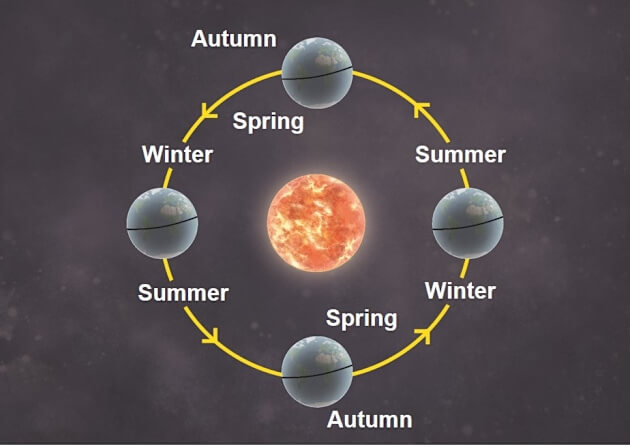
If you look at the earth from a distance away from the earth, you will find that the black side and the bright side have equal areas, and the earth's rotation is basically uniform. So why do we feel that the length of day and night changes? It turns out that the equatorial plane of the earth's rotation does not coincide with the plane of revolution (ecliptic plane), but forms an included angle, which is about 23.5°. This means that when the earth orbits the sun, even the same place is illuminated at different angles at different times!
When the earth moves into June and the sun shines directly into the northern hemisphere of the earth, it will be found that the bright side of the northern hemisphere is larger than the black side, that is, the day is longer than the night. This is the summer in the northern hemisphere where we are located. On the contrary, when the earth moves into December and the sun shines directly into the southern hemisphere, it will be found that the black area in the northern hemisphere is larger than the bright area, that is, the night is longer than the day. This is the winter in the northern hemisphere. In September and March, the earth's rotation axis is perpendicular to sunlight, and the length of night and day in the northern and southern hemispheres is the same.
In this way, the earth's revolution and rotation create the four seasons, as well as different climatic zones such as cold, temperate, and tropical. So is there a place on earth where the length of day and night does not change? Yes! On the Equator, the length of day and night is always equal. The closer we get to the North and South Poles, the more drastic the changes in the length of day and night will occur. At the North and South Poles, half a year of day and half a year of night will occur. In China, people on Hainan Island cannot easily appreciate the changes in the length of day and night, while people in Mohe, Heilongjiang and Altay, Xinjiang know that the days in summer are much longer than winter.