
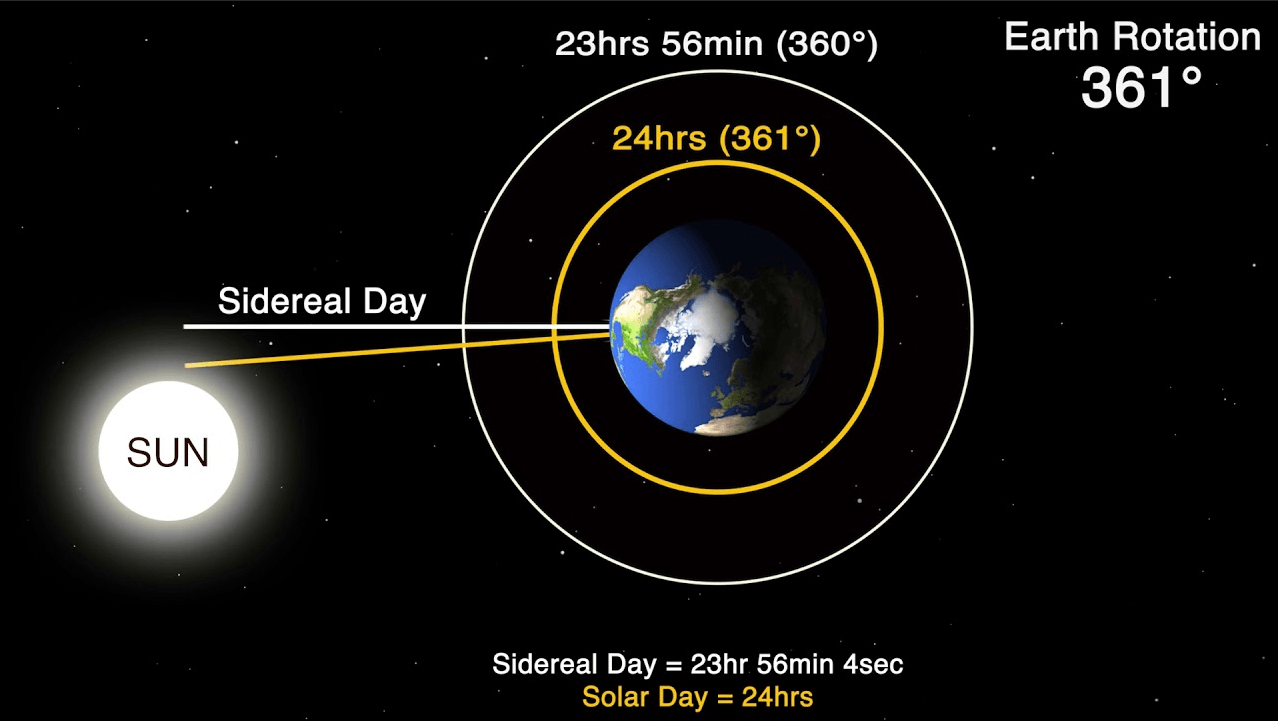
The day is a unit of time that we know well. The earth's rotation is a day, but how long is a day? In fact, in the eyes of astronomers,"day" has different meanings.
In the northern hemisphere, when a celestial body moves due south, we call the celestial body at "upper transit." The time interval between the sun's two consecutive summers is called a "solar day" and its duration is about 24 hours. If the object is a star, then the time interval between its two consecutive summitums is called a "sidereal day", and its time length is about 23 hours and 56 minutes. In other words, a sidereal day is 4 minutes shorter than a solar day.
Where have these 4 minutes gone? It turns out that because the earth also revolves while rotating, the direction of rotation and the direction of revolution are roughly the same. Therefore, the solar day combines the effects of revolution and rotation, which is 24 hours. The sidereal day only takes into account the earth's rotation, so it is shorter by about 4 minutes.
Astronomers have found that neither solar nor sidereal day remains static. Nowadays, many observatories in the world have extremely accurate "atomic clocks". They use the stable vibration of atoms to record time, allowing astronomers to discover that there are slight changes in the unit of time "day": the earth turns slightly slower in March and April, and it turns slightly faster in August. This small change is impossible to detect and can only be discovered with an accurate atomic clock.