
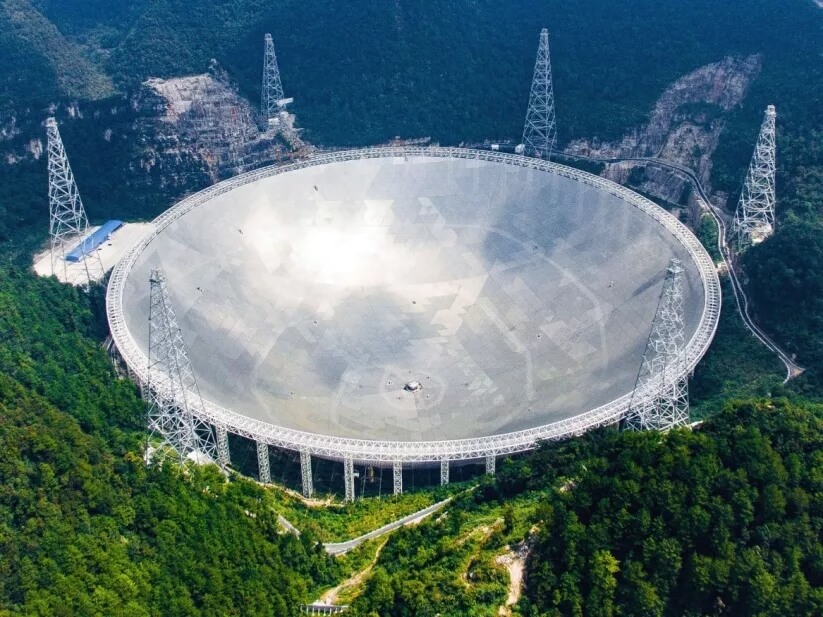
Why the bigger the telescope, the better If you have the opportunity to visit the observatory, you will definitely be amazed at those huge telescopes! Each telescope is like a large barrel. The larger telescope can easily hold a person, and the smaller telescope cannot be carried with both arms. Astronomers rely on these big guys to observe distant objects. Why use a large-aperture telescope to observe? What advantages do they have?
The telescopes we see have a unified name called "optical telescopes", and they receive visible light from distant celestial bodies. Due to the distance, the light from these celestial bodies is very weak. How can we collect these faint light? This is like using basins to pick up rainwater when it rains. If you want to pick up more rainwater in the same time, the best way is to use a basin with a diameter as large as possible. Similarly, collecting more light requires a telescope with a larger aperture. The diameter of the human eye's pupil can reach 7 mm in dark environments. Today, the world's largest optical telescope has a diameter of 10 meters, which is 2 million times the ability of the human eye to collect light in terms of area. This is the power of the big telescope!
However, the power of large telescopes is not limited to that. Through telescopes, we always want to see clearer details of celestial bodies. For example, when observing a star cluster, we expect to be able to "resolve" each star, rather than seeing a bunch of stars crowded together and blurred. There is a law in optics that the resolution power of a telescope is proportional to the aperture. That is to say, the larger the aperture of the telescope, the finer the celestial information it can distinguish. It seems that large telescopes can not only collect more light, allowing us to see dimmer and weaker celestial bodies, but also "see" more clearly.