
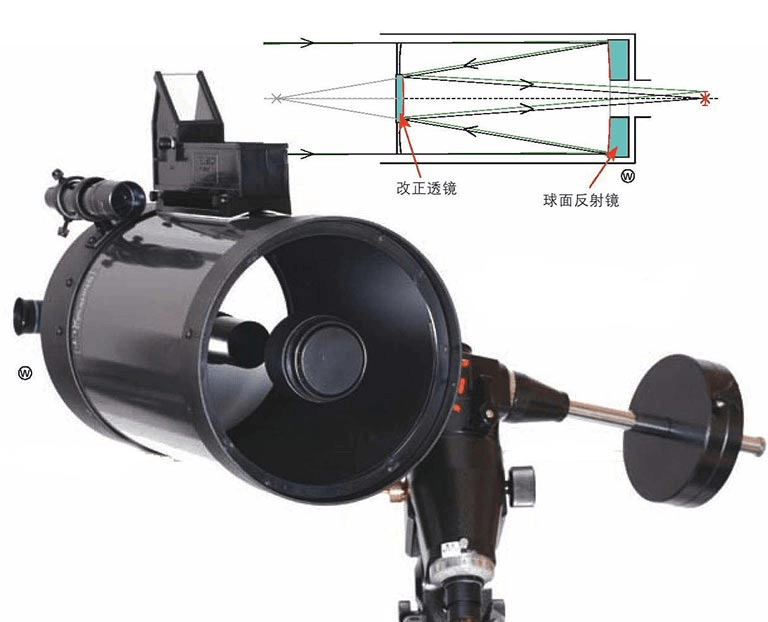
Why do you need catadioptric telescope?
In the early part of the 20th century, German Schmidt designed a telescope with both a spherical reflector and a transmissive glass lens. The main body of this telescope is a spherical mirror, which is responsible for collecting light and imaging. Adding a correcting lens with a special curvature in front of the spherical mirror can effectively improve the imaging quality at the edge of the field of view. Schmidt's telescope has an advantage that other telescopes don't have-it can clearly image a large range. Later, people called this telescope combining a spherical mirror and a correcting lens a "catadioptric telescope", and the catadioptric telescope designed by Schmidt was called the "Schmidt telescope."
One problem with the Schmidt telescope is that the correcting lens with complex curvature is very difficult to grind. Soviet optician Maksutov designed a relatively simple catadioptric telescope. Replacing the complex correction lens with a thick meniscus glass lens can also achieve the purpose of increasing the field of view. This catadioptric telescope was later called the "Maksutov telescope" because it was cheaper to manufacture than the Schmidt telescope and was widely used in small telescopes.
The advantage of catadioptric telescopes is that they have a large field of view and are suitable for "sky survey observations", that is, to simultaneously observe multiple targets in the large sky region. Ordinary telescopes have low efficiency in surveying the sky due to their small field of view. With the use of catadioptric telescopes with a large field of view, the efficiency of sky surveys has been greatly improved. At the same time, there are many variants of catadioptric telescopes, such as the Schmitt-Cassegrain telescope and the Maksutov-Cassegrain telescope. Although the field of view is not very large, they are compact in structure and excellent imaging quality. They are widely used in astronomy. Science telescope used by enthusiasts.