
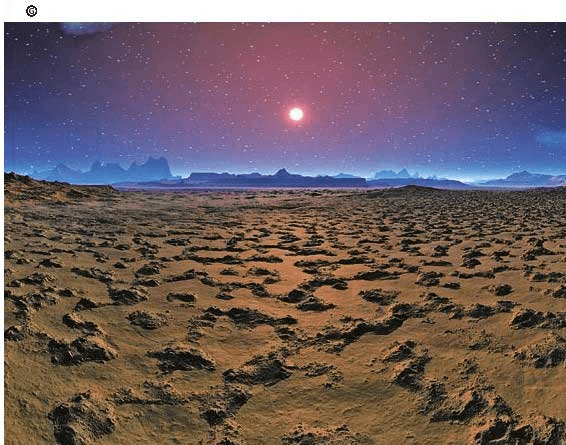
In the infinite universe, the earth and the moon are the two planets closest to each other. The earth has water, vegetation and vitality; the moon has seas (lunar seas) without water, mountains (craters) without trees and no life. On the moon there are Chang'e, Wu Gang, white rabbits and osmanthus trees, such as people and animals, is only a beautiful imagination, in fact does not exist. One of the most fundamental differences between the Earth and the Moon is the presence or absence of vegetation.
"Vegetation" is the general term for plants that cover the surface of the earth. In different seasons, people use different quilts, such as towel quilts, silk quilts, eiderdown quilts, etc., to protect and warm their bodies. Vegetation is like a quilt covering the earth, also protecting the earth. However, the role of vegetation goes far beyond the meaning of protection. They also directly or indirectly nourish all living things on earth, including humans. The necessary conditions for living things to survive are the supply of oxygen, water and food. Plants are precisely the providers and regulators of these three necessary conditions. Without plants, there would be no other living things on earth.
The earth's surface atmosphere contains about 25% oxygen. If this oxygen content is regarded as 100%, the oxygen content in the air will drop by 10% for every 1000 meters increase in altitude. Everyone knows that without oxygen, people will suffocate and die. Even at an altitude of 3000 meters, due to the significant drop in oxygen content in the air, some people will begin to experience altitude reactions and feel difficulty breathing. At altitudes above 7000 meters, it is already unbearable for ordinary people and can develop altitude sickness. Where does the oxygen on earth come from? In the process of biological evolution, green plants have acquired the ability to use solar light to synthesize water and carbon dioxide into sugars while releasing oxygen. In the evolution of the earth, with the emergence and development of green plants, oxygen in the earth's air has become more and more abundant, reaching the current relatively stable balance state. When plants synthesize sugars, the carbon dioxide absorbed by plants comes from the breathing of living things or various combustion processes on earth. On earth, plants are the key to the mutual conversion and balance of oxygen and carbon dioxide, and their role is irreplaceable. It can be said that without plants, there would be no oxygen necessary for human breathing, and the necessary conditions for human survival would be lost.
Plants directly provide extremely rich food for humans. For example, grains such as rice and flour that humans need every day, edible oils such as soybean oil, sunflower seed oil, and olive oil, as well as various vegetables and fruits. All of these are taken from the roots, stems, leaves, flowers, fruits and seeds of the plant. They are rich in starch, protein, fat, and various vitamins needed for human health. In addition to food being directly eaten by humans, raw materials such as the cotton textile industry, sugar industry, wood processing industry, papermaking industry, and food processing industry also come from plants. Although the meat and dairy products consumed by humans come from animals, many animals, including livestock, such as cattle, sheep, pigs, chickens, ducks, geese, etc., rely on plants as their main food source. It can be seen that plants are at the foundation or bottom of the earth's food chain. Without plants, there will be no food source for humans and other organisms.
Although people do not mainly get a lot of water from plants, they also get part of the water when eating fresh fruits and vegetables, because the water content in fresh plants is about 90%. On earth, vegetation plays a key role in maintaining the dynamic balance of water, regulating temperature, and protecting soil. Some people compare the large forest to a large reservoir, which is no exaggeration at all. For example, if it rains in a desert area without plants, part of the falling rainwater will quickly penetrate into the ground, and another part will quickly evaporate into the atmosphere under strong sunlight. If there are plants, the falling rainwater will be absorbed first by the plants. The plants can also block the sun and prevent the rapid evaporation of water on the surface of the earth. The plants play a role in fixing and storing water on the surface of the earth. On slopes with no vegetation or few plants, when heavy rain falls, the rainwater will wash the earth. In the lighter cases, soil loss will be caused, and in the heavier cases, catastrophic mudslides will be caused. With vegetation, the roots of plants can penetrate deeply into the soil and firmly fix the soil. Therefore, people need to close mountains for afforestation, plant grass and trees in over-reclaimed areas to restore vegetation. All in all, where there is no vegetation, the environment can become very harsh, such as a barren desert or a desolate Gobi. Because plants play a crucial role on the earth, the first factor to be considered when maintaining ecological balance and maintaining biodiversity is plants.
Plants have formed many ingenious survival skills in the process of evolution. People learn and learn from these survival skills to benefit humans themselves. Imitating the delicate function of plants is also plant biomimetic. There have been many successful examples, such as long-span roof structures, serrated tools, nylon buckles, etc. There are many more complex and in-depth plant biomimetics that need to be further explored, such as: imitating plants in energy biomimetics efficiently utilize solar energy; imitating plants in molecular biomimetics fix and utilize nitrogen in the air under mild conditions to cleverly synthesize a variety of very useful organic compounds; imitating the solid structure of plants and the dexterous flight of wind-borne seeds in mechanical biomimetics; etc.
Plants are so important to human survival and life, so our understanding and understanding of plants is also very important. In the major fields of plant evolution and classification, plant structure and form, plant physiology and metabolism, plant ecology and environment, plant protection and utilization, plant genetic mysteries, etc., there are still many problems that are far from being fully understood and concluded. With the rapid development of modern science and technology, great progress has indeed been made in the understanding of plants. Not only can we gradually deepen our understanding, but we can also use some very advanced means, such as plant cell engineering and genetic engineering technology, to transform plants. Serve mankind better and more effectively. Therefore, human beings must establish awareness of understanding, utilizing and protecting plants from childhood, and stimulate interest in studying plants.