
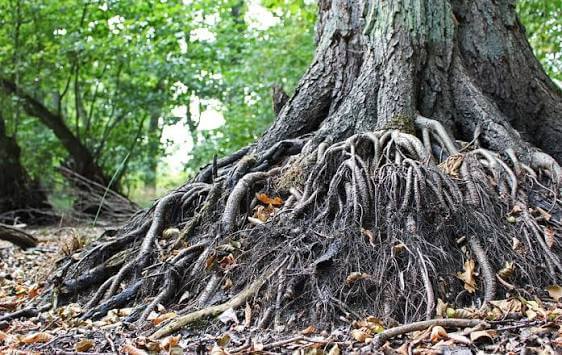
There are hundreds of thousands of plants with different morphological characteristics on the earth. Of course, their roots also have their own characteristics. In order to easily identify their "identity", botanists divide root systems into three major types: straight root systems, fibrous root systems and adventitious root systems.
As the name suggests, the root system has a main root that runs vertically downward. When it grows to a certain length, many smaller lateral roots will sprout around it. Similarly, the lateral roots can also grow into smaller roots. In other words, the root system consists of main roots, lateral roots and rootlets, which have obvious differences in primary and secondary thicknesses, such as the roots of soybeans and cotton. Fibrous root systems, on the other hand, are composed of many roots of similar thickness and size. There is no obvious difference between main roots and lateral roots. They are shaped like a clump of beards, such as the roots of rice and corn.
Compared with the above two types of root systems, adventitious roots not only have variable shapes, but also have no fixed growth area. Generally speaking, the roots of plants are formed by seed radicles and have relatively fixed growth parts. However, sometimes we can see that plants grow roots from stems, leaves or old roots. The growth parts of the roots are not fixed, so such roots are called adventitious roots by botanists. For example, there is a common ornamental plant called spider orchid. Its leaf clusters will draw out slender branches, which are flexible and drooping. In addition to germinating new leaves at the top, many fine roots will also grow in the air. These roots are adventitious roots, also known as aerial roots, and they can even grow new plants in the air.