
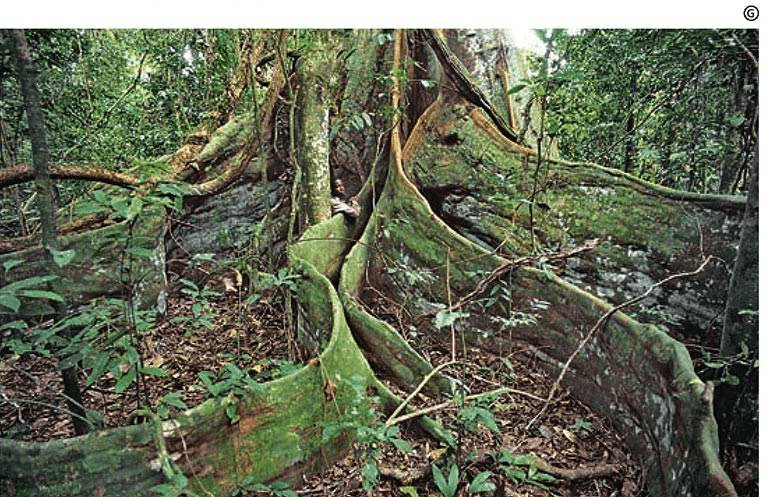
Walking into the lush tropical rainforest, you will immediately feel a strong atmosphere: pristine, quiet, humid and hot. Looking around, you will see towering trees everywhere. The dense canopy makes it difficult for the sun to penetrate through. There are many species of animals and countless plants. However, the most interesting things in the tropical rainforest are some strange big trees. At the base of their trunks, strange "big wooden boards" will extend around. They are thick and hard, some are three to four meters short and some are high. Some are five or six meters high, like a living wall. They are the unique landscape of the tropical rainforest-plate-shaped roots.
As we all know, the roots of plants go deep into the soil and are responsible for absorbing water, mineral nutrients and supporting the plant body. So why do big trees in tropical rainforests produce plate-like roots? Botanists tell us that all trees with plate-like roots are relatively tall, with a tree body usually reaching 50 meters or even higher, and the main trunk of the tree is almost the same as the top to bottom. To support such a tall body, especially during storms, it is not enough to rely solely on roots that extend into the soil. For example, we can see tall telephone poles in cities and villages, with bodies of the same thickness standing upright on the ground, but the taller the person is, the worse the stability is. Therefore, there are support equipment around the telephone poles to prevent it from falling down in the wind. The oddly shaped plate-shaped roots act like brackets around utility poles, shouldering the important task of supporting tall trunks, allowing the towering trees that rise from the ground to stand steadily upright. From this perspective, the plate root is also a kind of pillar root.