
Our bodies and the millions of substances around us are mostly composed of molecules, which in turn are composed of atoms of about a hundred different elements. But where do atoms come from? And how do they form molecules?
Approximately 13.8 billion years ago, a Big Bang created the universe we know today. The initial elements formed after the Big Bang were primarily hydrogen and helium (approximately 3:1). About 300 million years later, matter condensed and began to form stars. The high temperatures and pressures inside stars triggered thermonuclear reactions, synthesizing heavier elements such as carbon, oxygen, magnesium, silicon, and iron. Elements heavier than iron were produced under the violent conditions of supernova explosions.
Over hundreds of millions to billions of years of evolution, 94 elements, from hydrogen to plutonium, formed in the universe. If the story ended there, with electrons in each atom orbiting only its own nucleus and atoms completely isolated from each other, it would be a great pity. Because in that case, the world would only have atoms, no molecules, and certainly no life or anything else. How monotonous and dull such a world would be! Fortunately, the transfer and sharing of electrons between atoms made the formation of molecules possible, making a vibrant and colorful world a reality.
To understand why electron transfer and sharing occur between atoms, we need to look at the movement of electrons within the atom. In an atom, electrons revolve around a positively charged nucleus. This is similar to a satellite orbiting the Earth due to gravity. However, a satellite's orbital altitude is continuously variable, and satellites interact almost entirely independently. In an atom, however, many electrons are crammed into such a small space, and since electrons are negatively charged, they inevitably interact with each other. To maintain "order" within the atom, the movement of electrons must adhere to strict rules. Electrons must move along specific orbits, each orbit holding only two electrons. Furthermore, these orbits are arranged in layers, with electrons always starting from the innermost orbitals with the lowest energy. The consequence of this arrangement is that the outermost layer can have a maximum of four orbitals, meaning it can hold a maximum of eight electrons.
If all the outermost orbitals were filled with electrons, an atom would be like being covered with a complete blanket, extremely "comfortable." It would be "indifferent" to other atoms, existing stably only in a monatomic state. If all atoms were like this, there would be no molecules, and no you or me. Fortunately, there are only six such elements: helium, neon, argon, krypton, xenon, and radon. We call them inert elements.
In the atoms of most elements, the outermost orbitals are not fully filled. It's like an atom is covered by a tattered blanket and feels "uncomfortable," so it tries its best to have a complete blanket.
One method is electron transfer. When the number of electrons in the outermost shell is just one or two short of eight (for example, a chlorine atom has seven electrons in its outermost shell), the simplest way is to "grab" electrons from other atoms. This is equivalent to using material from "someone else's" quilt to patch a hole in your own. However, when the number of electrons in the outermost shell is very small (for example, sodium has only one), it's like having only some scraps of cloth, not a quilt at all. A better way is to simply "discard" those few electrons, since there are still complete "clothes" (inner shell electrons) inside. With one "wanting" and the other "willing to give," electrons are transferred from one atom to another. The atom that gives electrons becomes positively charged, and the atom that receives electrons becomes negatively charged, and they are "tied" together by the attraction of their charges. Sodium chloride (table salt) is formed in this way.
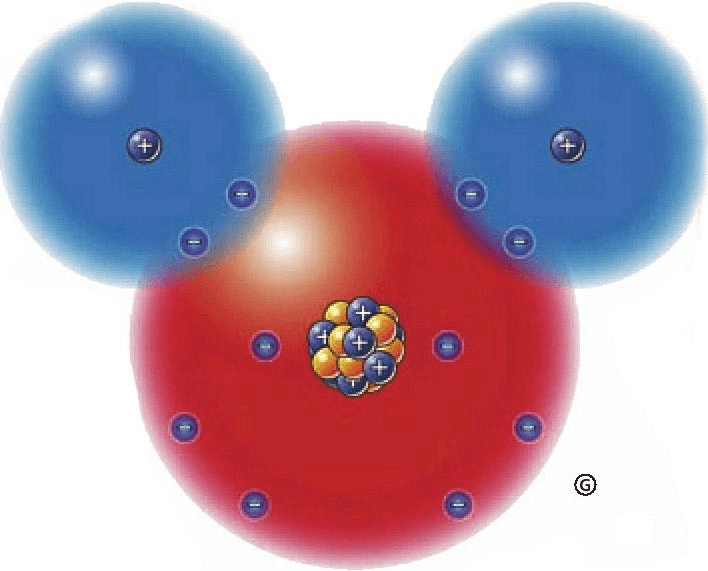
There's another way to gather eight electrons in the outermost shell: electron sharing. You donate one electron, I donate one electron, and we share them, essentially giving each atom an extra electron. These two electrons orbit the nuclei of both atoms simultaneously, "tying" the two atoms together. It's like two atoms piecing together their incomplete blankets to form a complete blanket, sharing it. This sharing can occur between atoms of the same type, such as two oxygen atoms sharing two pairs of electrons to form an oxygen molecule (O2); it can also occur between different atoms, such as an oxygen atom and two hydrogen atoms sharing electrons to form a water molecule (H2O). Many molecules, including biological macromolecules in our bodies, such as proteins and nucleic acids, are formed through electron sharing.
Therefore, the formation of molecules is the result of the transfer and sharing of outer electrons between atoms. Although this only affects the "surface" of atoms, it is the foundation for the formation of all kinds of matter in the world and makes the emergence of life possible.