
In ancient times, both Orientals and Westerners believed that matter was composed of the most basic "elements." In China, these "elements" are gold, wood, water, fire, and earth. In ancient Greece, it was earth, air, water, and fire.
In modern times, these "elements" cannot withstand the test of science. For example, French chemist Lavoisier proved that water can be formed by burning hydrogen in oxygen. Later, people also discovered that electricity can decompose water into hydrogen and oxygen, so water is not an "element." Another so-called "element", air, was found to be about one-fifth oxygen, and the rest was other gases that did not support combustion (mainly nitrogen), so air was not an "element" either. Therefore, scientists define an "element" as a substance that can no longer be decomposed by chemical methods. Hydrogen, oxygen, nitrogen, chlorine, carbon, sulfur, phosphorus, iron, copper, gold, silver, etc. are the real "elements" that make up substances.
In 1789, the French chemist Lavoisier published a list of 33 chemical elements. Subsequently, there was a craze to search for new elements in Europe, and the number of elements discovered quickly reached more than 60. These elements have different properties and appear chaotic. This situation makes people feel confused: How many elements are there in the world? What is the relationship between the elements? How to find new elements?
Scientists made various efforts to find patterns, but the results were unsatisfactory until Russian chemist Mendeleev found the "code" to crack the elements. The biggest difficulty Mendeleev faced at that time was that among the elements that had been discovered, the atomic weights of some had not been measured accurately, and some had not yet been discovered. It was even more difficult to find the rules in such an arrangement.
Mendeleev was not discouraged. He wrote the atomic weights and main properties of the 63 elements that he knew at that time on cards, and repeatedly grouped them to find patterns. He found that if elements were arranged from small to large atomic weights, an element with similar properties to the previous element would appear every distance. This rule occurs repeatedly, but is separated by some elements. If elements with similar properties are arranged in parallel, the periodic table of elements is formed.
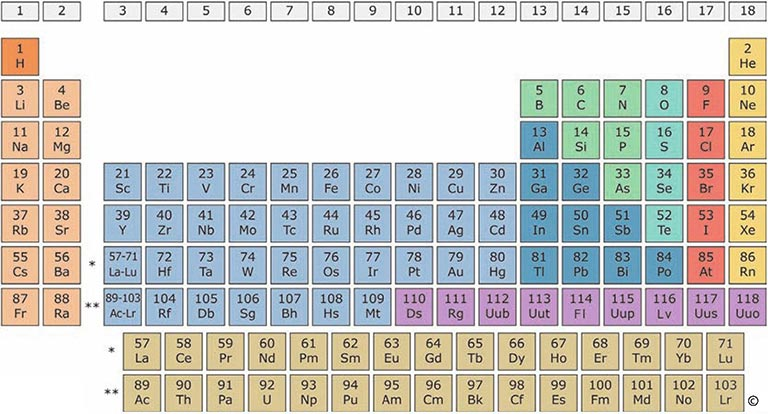
In 1869, Mendeleev published the first periodic table of the elements (rotated clockwise by 90°): each row is a period, and the properties of the elements gradually change from metal to non-metal; each column is a family, and the properties of the elements are similar to each other, and the rule that the properties of the elements change periodically as their atomic weight increases is revealed.
In addition to personally re-measuring the atomic weights of some elements, Mendeleev also made judgments based on the properties of the elements, such as correcting the atomic weight error of beryllium. He also left a vacancy in the periodic table, believing that this was a position that had not yet been discovered should occupy, and predicted the "aluminum-like" and "silicon-like" properties. Later, the discovery of gallium and germanium confirmed his prediction.
Later, British scientist Mosley discovered that the number of positive charges in the nucleus (atomic number) determines the chemical properties of the element. The periodic table actually reflects the periodic changes in the number of electrons in the outermost layer of the element as the atomic number increases, which reveals the periodic law. The real reason behind it. Mendeleev discovered the periodic law of elements based on incomplete and accurate atomic weights and sequences with gaps, which reflected his keen insight and intelligent imagination.