
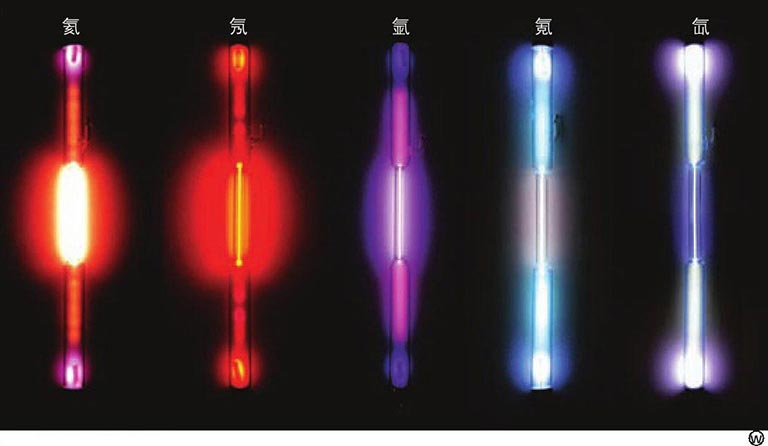
Why were rare gases once called "noble gases" The main component of the Earth's atmosphere is nitrogen (about 78% of the total volume), followed by oxygen (about 21%). There are also six gases, including helium, neon, argon, krypton, xenon, and radon, accounting for about 0.94%. Due to their low content in the atmosphere, people collectively refer to them as rare gases. Compared with nitrogen and oxygen, these gases account for less than 1% of the total volume, but there are more "rarer" gases in the atmosphere. For example, the content of argon in the atmosphere reaches 0.9%, which is 30 times that of carbon dioxide in the atmosphere (about 0.03%)! Although the content of helium in the earth's atmosphere is rare, its content in the universe is not low, at about 27%, second only to hydrogen.
People have long wanted to know what was in the air. By the 1770s, chemists finally discovered and recognized oxygen in the air, which could help combustion and breathing, and also discovered the less reactive nitrogen. Because rare gases are less reactive, people still did not know about their existence for a full 100 years after the discovery of oxygen, nitrogen, carbon dioxide and other gases. It was not until the end of the 19th century that scientists successively discovered elements such as helium, neon, argon, krypton, and xenon, and soon discovered radioactive radon.
When chemists studied these elements, they found that the outermost electron numbers of their atoms were saturated. This was a stable electronic layer structure, so their chemical properties were very inactive. Under normal circumstances, it is difficult for these elements to react with other substances to form compounds in the general electron-transfer or electron-sharing form. Even the atoms of these elements themselves do not bind to each other, so their molecules are composed of single atoms, unlike hydrogen, oxygen, nitrogen, etc., which are composed of two atoms. It is precisely because the chemical properties of these gases are particularly "lazy" and similar that people call them "inert gases." Due to this characteristic, their valence is zero and are included in Group 0 elements in the Periodic Table of Elements.
However, in 1962, a young British chemist, Bartlett, synthesized a xenon-containing compound for the first time, xenon hexafluoroplatinate (XePtF6), rewriting the history of inert gases without compounds and overturning the 70-year-old traditional saying that rare gases are completely chemically inert. This attracted great interest and attention from the scientific community at that time. After that, a variety of inert gas compounds were synthesized like bamboo shoots after rain, so that the name "inert gas" no longer fully conforms to the facts. Therefore, more people now refer to these six gases as rare gases.