
#Why salt grains are cubes The salt grain looks like a cube, which is related to its internal structure. The chemical composition of table salt is sodium chloride, which contains two ions: chloride ions and sodium ions. We can think of these two ions as two different building blocks. Salt grains are built from these two building blocks strictly according to certain rules: 6 sodium ions are connected to each chloride ion in six directions, front, back, left, and right, and up and down. Similarly, each sodium ion is connected to these 6 directions. There are also 6 chloride ions connected to it. Countless ions are stacked like building blocks according to this rule to form a cubic salt crystal.
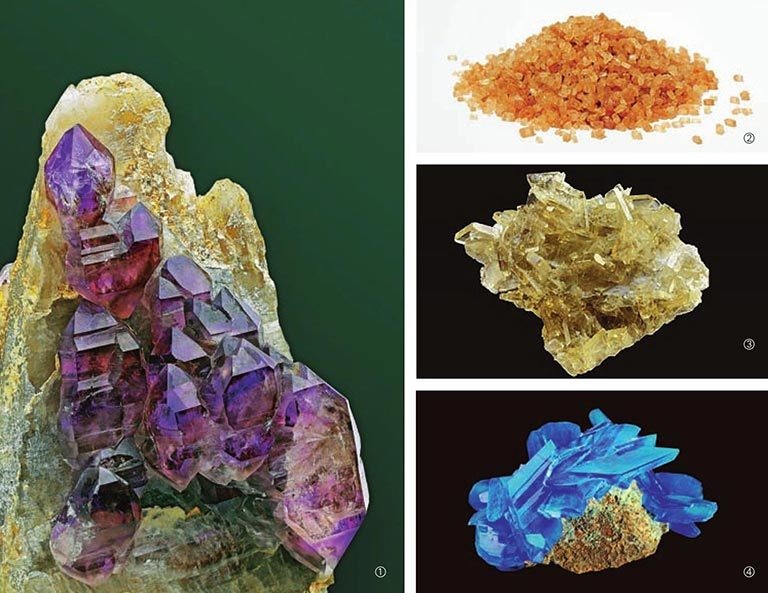
Most solid substances in nature exist in the form of crystals. Common crystals include purple-blue gemstones (amethyst), brown sugar crystals, barite (a barium ore, the main component is barium sulfate), and bile alum (copper sulfate). In addition, there are diamonds, precious stones, crystals, mineral raw materials in industrial production, inconspicuous sand, sand and soil, ice crystal particles floating in the atmosphere... Crystals are everywhere.
People came into contact with and understood crystals quite early. In ancient times, people noticed some characteristics of crystals: The Han Shi Biography recorded that "five flowers and trees appear, and only six snowflakes appear"; Volume 10 of the Stone Part of "Compendium of Materia Medica" by Li Shizhen in the Ming Dynasty mentioned the description of stone gall in the "Tu Jing Materia Medica" of the Northern Song Dynasty, saying that "the big one is like a fist, and the small one is like a peach chestnut. When struck vertically and horizontally, they all form a superimposed text." This shows that the ancients observed the crystal carefully and noticed its unique shape and similar artificial edges or planes. This was people's initial understanding of the crystal.
Until the beginning of the 20th century, scientists used X-ray technology to discover that molecules or ions in crystals were not randomly stacked together, but were arranged repeatedly in strict compliance with certain rules. There are many rules for the arrangement of particles inside a crystal, and the unique shape of the crystal is a reflection of the arrangement of particles inside its own body to a certain extent. Therefore, the criterion for whether an object is a crystal should be based on whether the internal particles completely conform to certain arrangement rules, rather than simply judging by characteristics such as shape and transparency.
Silicon dioxide, the main component of glass, is arranged in an irregular network structure, so glass is not a crystal. For a long period of history, people often believed that substances with regular shapes and transparent shapes were crystals. In fact, many objects that seem opaque or have no regular shapes are actually crystals. For example, the common gold, silver, copper, and iron are metal crystals. Because the metal bonds between metal atoms have no directionality, metal crystals often have good ductility and are easier to forge into various shapes; on the contrary, some seemingly crystal clear objects are not crystals, such as glass, rosin, plastic, etc. are not crystals.