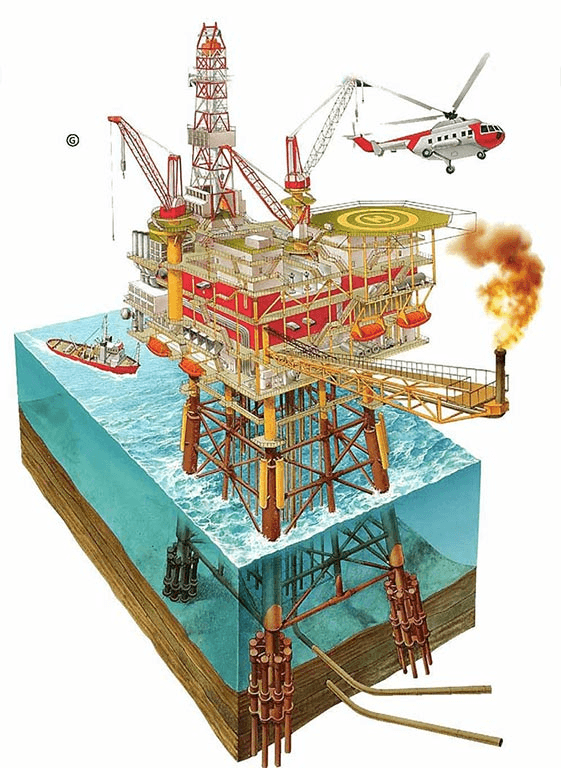
In science fiction movies, the protagonist uses high-tech earth-boring equipment to travel underground and even through the center of the earth. However, as far as the current actual level of science and technology is concerned, humans are still unable to achieve "core roaming." So far, they have only drilled into the earth's crust and have not yet entered the mantle layer. The scientific drilling project is known as the "telescope that reaches into the earth" and is the only direct way to obtain information on the earth's interior. On the one hand, it can obtain materials from the depths of the earth, and on the other hand, scientific equipment can be placed in the drilling for monitoring to obtain more information. The thinnest outer layer of the solid earth is the crust, of which the oceanic crust is much thinner than the continental crust. Therefore, when scientific drilling was carried out in the mid-20th century, American scientists proposed an initiative to use deep-sea drilling to penetrate the Moho surface at the thinnest part of the earth's crust to study the age of the earth, the material composition and internal functions of the mantle. This is the famous "Moho Plan." In 1968, the United States started its deep-sea drilling program using the deep-sea drilling ship "Groma Challenger", with the deepest seabed drilling reaching 1741 meters. Since then, countries around the world, including China, have participated in the plan, creating a new wave of offshore drilling craze. A large number of research results have been obtained in ocean drilling, which confirmed the spread of the seabed, established the plate theory, and at the same time led to the establishment of a new discipline of paleooceanography, bringing a revolution to earth science. Compared with ocean drilling, continental scientific drilling started later. In 1970, the Ministry of Geology of the Soviet Union carried out several scientific drilling on the Kola Peninsula and other places. The deepest drilling depth reached 12261 meters, which is also the largest depth of human penetration to date. Later, Germany conducted the world-famous KTB scientific drilling in central Germany from 1987 to 1994, with a final drilling depth of 9101 meters. On June 25, 2001, the the mainland of China Scientific Drilling Project, known as the "First Well in China," started. The drilling site was Donghai County, Jiangsu Province. It was successfully completed on January 23, 2005, with a drilling depth of 5118 meters. This drilling is of great significance for studying the origin and evolution of the mainland of China. The results of deep-sea drilling and scientific drilling often exceed the expectations of earth scientists. For example, scientists generally believe that the earth's crust can also be divided into two layers, upper and lower, but drilling shows that this layer is not universally applicable, and the earth's crust in some areas does not have this layered structure. In addition to new geological and geophysical discoveries, what is surprising is that many scientific deep drillers have found large numbers of high-temperature and anaerobic bacteria deep underground. In the past, it was generally believed that as the ground temperature rose to 100 ° C, life could not exist deep underground. However, scientific drilling conducted in Sweden found that living things can survive as deep as 4200 meters underground, and the temperature is about 110 ° C. These high-temperature and anaerobic life may have originated in the early days of the earth's formation, when the atmosphere and hydrosphere were not fully developed.
How deep can humans drill into the ground?
This paper focuses on the depth at which humans can drill underground, pointing out that existing technology can only drill to the earth's crust. It introduces the Moho plan, the specific situation of ultra-deep drilling in many countries, and drilling results, such as confirmation of seabed expansion and discovery of high-temperature resistant anaerobic bacteria in deep underground.