
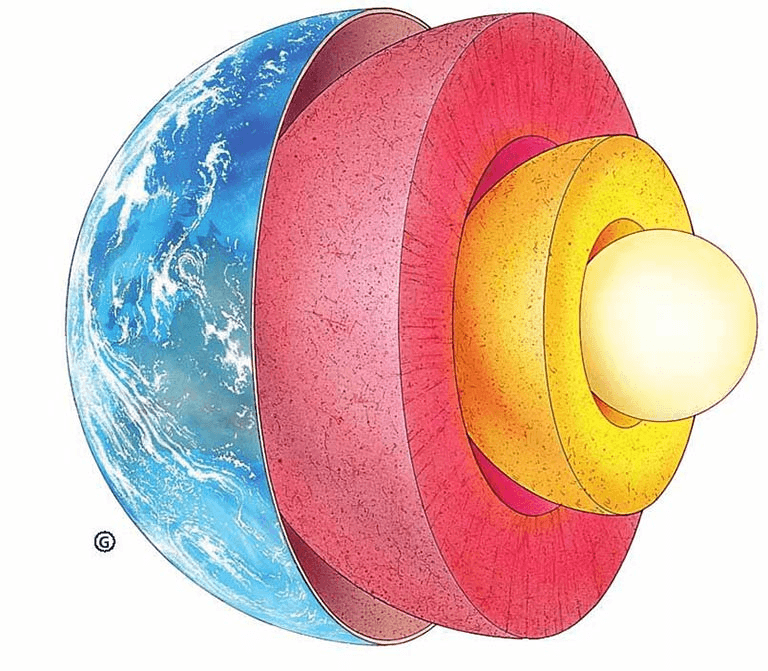
Why is the earth like an undercooked egg? Humans living on the surface of the earth have always been curious about the interior of the earth, but today's technological means are not enough for us to directly observe and study underground. However, earth scientists have come up with other ways to understand the earth's internal structure, such as using seismic waves: when buried explosives explode, a small earthquake will be triggered, and the generated seismic waves will travel in all directions. After the seismographs installed on the ground receive underground seismic waves, they can analyze many underground situations. This is the artificial seismic exploration method currently used when searching for underground resources. However, the seismic waves generated by such artificial earthquakes can only penetrate thousands of meters underground. Therefore, if you want to understand the deep structure of the earth, you can only use the seismic waves generated by natural earthquakes.
Natural earthquakes have huge energy, and the generated seismic waves can "travel" throughout the entire body of the earth in tens of minutes. The propagation speed of seismic waves is related to the nature of the medium they pass through. Seismic waves can be divided into longitudinal waves and transverse waves: longitudinal waves can propagate both in solids and liquids, while transverse waves cannot propagate in liquids. If the medium inside the earth is not uniform, seismic waves will be reflected and refracted at the interface between the two media. Based on the recorded arrival times of various waves, the seismic wave velocities at different depths underground can be calculated, and then the characteristics of the earth's internal structure can be described.
In August 1909, an earthquake occurred near the capital of Croatia. When local scholar Mohorovic studied the information collected by seismographs, he found that the velocity of seismic waves suddenly increased tens of kilometers underground, indicating that there was an interface here. There is a significant difference in the composition or structure of materials above and below the interface. This interface was later called the Mohorovic discontinuity, or Moho surface for short. Below the Moho surface, the deeper the seismic wave is, the faster the speed, but at a depth of about 2900 kilometers, the speed of longitudinal waves drops rapidly from 13.7 kilometers/s to 8 kilometers/s, and the shear waves stop propagating. This interface was first discovered by Gutenberg in 1914, so it is called the Gutenberg surface.
Based on these two interfaces, earth scientists divide the earth's interior into three layers: the earth's surface above the Moho surface is called the crust, the part of the earth between the Moho surface and the Gutenberg surface is called the mantle, and the part below the Gutenberg surface to the center of the earth is called the core. If the earth is compared to an egg, the outermost thin crust is like an egg shell; the core at the center is the egg yolk; and what surrounds the core like egg white wrapped in the egg yolk is the mantle.
Three large layer circles have been determined, but is the interior of each layer uniform? The answer is no. By further using seismic waves to "illuminate this bright lamp", geologist Conrad discovered in 1923 that the earth's crust can also be divided into two layers, the upper layer is rich in silicon and aluminum, and the lower layer is rich in silicon and magnesium. The mantle can also be divided into two layers: the upper mantle and the lower mantle. In the upper part of the upper mantle, there is an asthenosphere, which stores a large amount of flowing magma. The upper mantle part at the top of the asthenosphere and the crust together form the lithosphere, moving on the asthenosphere. The outer layer of the earth core is the outer core. Because the shear waves cannot propagate, it can be seen that it is liquid (or in a molten state). The inner layer of the earth core is the inner core, and the shear waves of the inner core can propagate, it can be seen that it is solid. Therefore, this extra-large "egg" on Earth is not cooked too well, and part of its "egg yolk" is still in a liquid state.