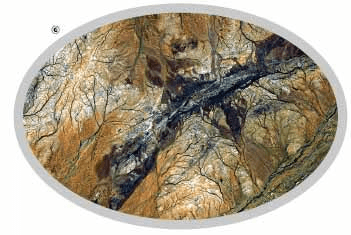
How was land formed? Earth is the only planet in the solar system that has both continental and oceanic crusts. The solid shell composed of rocks on the earth's surface is the foundation for living things to stand on. The continental shell is more than 30 kilometers thick, and the ocean shell is less than 10 kilometers thick on average. From the bottom of the earth's crust to a depth of about 2900 kilometers is the mantle, and from the bottom of the mantle to the center of the earth is the core. The oldest preserved mineral on earth is zircon, with a chemical composition of zirconium silicate. Jack Mountain photographed by satellite. When was the mainland and land formed? Since the early history of the earth was hidden by long evolution and was difficult to trace, this is an unsolved mystery. In 2001, geologists from the United States and Australia discovered the oldest mineral zircon from Mount Jack in Western Australia. It was identified that it belonged to the earth's crust or appeared 4.4 billion years ago. Zircon has a high melting point and high hardness, and it is difficult to disappear once crystallized. These characteristics make it an excellent sample for geologists to judge the age of the formation of the earth's crust. At present, it can be confirmed that permanent continental crust appeared in large quantities in the Archean era between 3.8 billion and 2.5 billion years ago, such as the ancient metamorphic rocks with an age of 3.5 billion to 3.8 billion years in the Isuhua area of Canada, the ancient continental crust of South Africa, and the oldest rock in North China in China, which is also over 3 billion years old. The continental crust is our foothold, floating above the mantle. Today, there is still a high-temperature mantle melting inside the earth and a young continental crust growing. Melted magma from the mantle forms the oceanic crust, which reacts with water at the ocean floor. When the water-containing oceanic crust is melted again through subduction, granite is formed, constituting the main body of the continental crust. Scientists thus realized that water on earth is crucial to the formation of continental shells. Without water, there would be no granite that makes up the continental crust. In other words, without oceans, there would be no land.
How was the land formed?
This article focuses on the issue of land formation, showing that the Earth is the only planet in the solar system that has both continental and oceanic crusts. Through research on zircon from Jack Mountain in Western Australia, it is pointed out that the oldest crust of the earth appeared 4.4 billion years ago, and the permanent continental crust was formed in large quantities in the Archean era. It is also mentioned that water is crucial to the formation of the continental crust.