
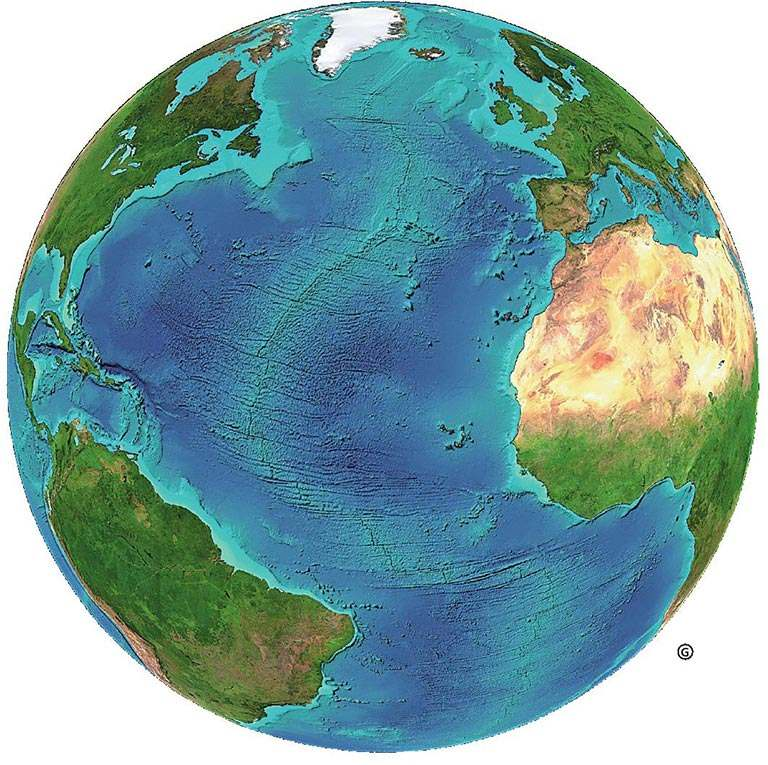
As early as the end of the 16th century, French map publisher Yautelius discovered that the shapes of the continents on both sides of the Atlantic Ocean could be put together. He believed that "earthquakes and floods tore the Americas apart from Europe and Africa." Over the following hundreds of years, more and more people noticed this strange phenomenon, and everyone slowly realized that perhaps long ago, the continents on earth were gathered together.
German meteorologist Wigner found that not only do the contours of coastlines on both sides of the Atlantic Ocean match, but there are also many other similarities. There are even various similar fossils and geological phenomena between other continents around the world. For example, although the continental environments and climates of today's Africa, South America, India, Australia, Antarctica and other places are very different, fossils of the same kind are widely preserved in their Carboniferous and Permian strata, including a fossil of the tongue fern plant that grew in cold climate conditions and a fossil of the middle dragon that lived in fresh water or brackish water; the folded mountain system in Newfoundland in North America corresponds to the folded mountain system in Northwestern Europe and Scandinavia, and both belong to the Early Paleozoic orogenic belt; The late Paleozoic structural directions, rock sequences and fossil facies in southern Africa and southern Argentina in South America are surprisingly consistent.
Based on many evidence, Wigner formally proposed the "continental drift" hypothesis in 1912, and improved and developed it in the book "The Origin of the Land and Sea" published in 1915. Wigner proposed that before the Mesozoic Era, all continents on the earth were once unified giant landmasses, called Pangaea or United Palaea; since the Mesozoic Era, the Pangaea split and drifted, and each continent gradually reached its current position.
After the continental drift hypothesis was proposed, it has not been widely recognized for many years. The biggest reason is that Wigner cannot reasonably explain what forces make the continent drift. It was not until the 1950s, due to the rise of paleomagnetism and the development of remote sensing, computer and other technologies, scientists found a large amount of new evidence to confirm that various continents did indeed drift significantly, and they are still moving slowly today. The continental drift hypothesis was gradually accepted. On this basis, the theory of seabed spreading and plate tectonics were subsequently developed, pointing out that the continent actually drifts driven by plate motion.