
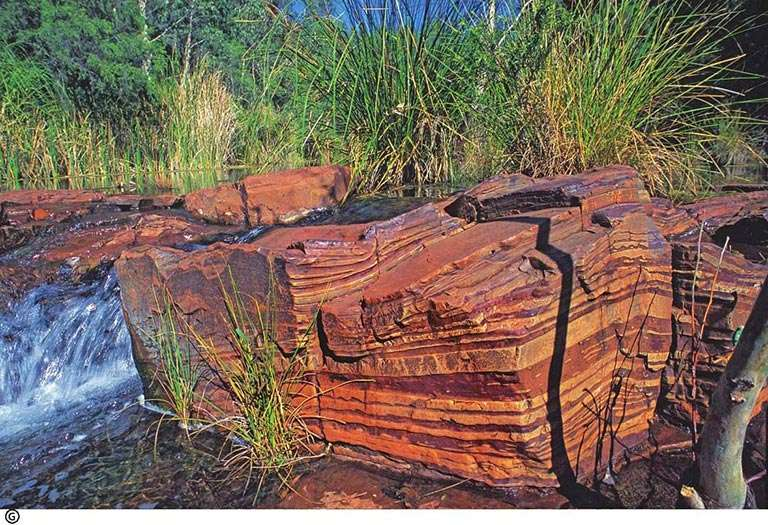
Ordinary rocks fill our daily vision. How is the age of these rocks revealed? For a long time, geologists could only determine the relative old relationship between different rocks, but could not accurately know their specific ages. The research method used at the time was called relative geochronology. Relative geochronology mainly relies on research methods such as strata, rocks, paleontology and paleomagnetism. Based on characteristics such as stratigraphic sequences and sedimentary structures, it is possible to identify which rock formations were formed earlier and which were formed later; in different strata, the preserved biological fossils are different, and according to the evolutionary order of organisms, the order of stratigraphic sedimentation can be identified; At the same time, organisms around the world are similar, so global strata can be compared; Some rock formations with special rocks or minerals can be used as indicators to determine relative geological ages. For example, strip magnetic quartzite was only formed between 1.8 billion years ago and 800 million to 700 million years ago; the order of changes in the Earth's magnetic field can also be used to determine relative geological ages.
Relative geochronology cannot tell the precise age of rocks, so it has limitations that cannot be ignored. Moreover, the methods of strata and biological fossils are mainly aimed at sedimentary rocks, but most of the other two types of rocks-igneous rocks and metamorphic rocks-are not produced in the form of strata, making it much more difficult to determine their relative freshness. It was not until the beginning of the 20th century, when relative geochronology reached such a bottleneck period, a major breakthrough in physics brought a new dawn to geology-absolute geochronology was born. Absolute geochronology is essentially radioisotope chronology. Isotopes refer to a class of atoms with the same number of protons and different numbers of neutrons in the nucleus of the same element. They occupy a common position in the periodic table of the elements. Some isotopes are unstable and can spontaneously emit various rays and are called radioisotopes. While emitting various rays, these isotopes decay into other isotopes, such as potassium decay into argon. All radioactive isotopes follow a law: the rate at which the radioactive isotope before decay transforms into a new isotope is only proportional to the original number of atoms; more intuitively, the atomic nucleus of a certain radioactive element decays, no matter how many atoms there are, as long as it decays to only half the number remains, the time (half-life) required will remain unchanged.
There are trace amounts of radioactive isotopes in the chemical elements contained in rocks and minerals. If you know the content of a certain radioactive isotope and the new isotope produced by its decay in the sample, based on their ratio and the known half-life time, it is equivalent to seeing the time displayed by the "isotope clock", which can accurately calculate the age of rock formation. The principle may seem simple, but there is a basic prerequisite to ensure that during the long geological history, this isotope in rocks and minerals changes naturally only through decay, without any loss or addition. In other words, geologists must find a very closed "box" in the rock to ensure that the radioactive isotopes inside are not affected by any external influence over the long historical period. After years of experimental research, scientists have found some minerals with good sealing properties. They can well preserve radioisotope information in rocks and are found in large quantities in magmatic rocks and metamorphic rocks formed in various periods, such as zircon, monazite, biotite, etc.
At present, the isotope decay systems commonly used by geologists to determine the age of rocks include uranium-thorium-lead, samarium-neodymium, rubidium-strontium, potassium-argon and carbon-14. The time constants for the decay of different radioisotopes are long and short. For example, the half-life of the uranium-thorium decay system is very long, which is suitable for determining ancient rocks with a history of hundreds of millions of years; the half-life of carbon-14 is only more than 5000 years, so it is used to determine the age of younger rocks. Therefore, scientists can choose the right minerals and use reasonable isotope decay systems to determine the age of a wide variety of rocks.