
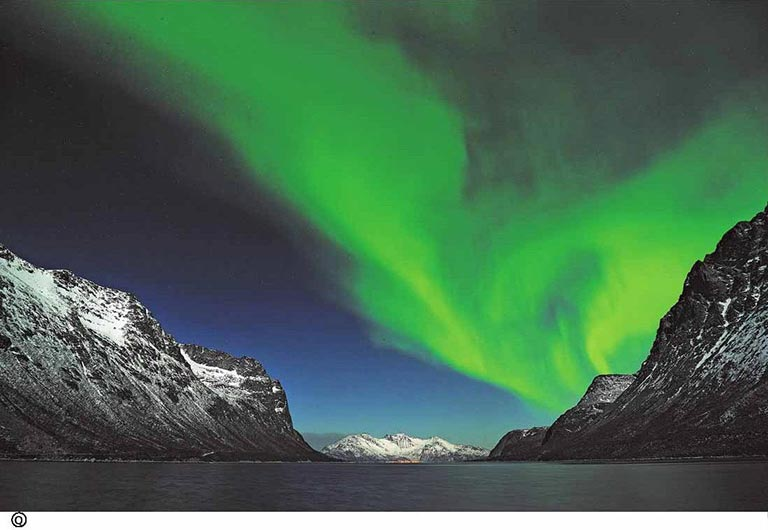
Why are there beautiful aurora over the polar regions
In the sky above high latitudes, a kind of colorful light often appears. Large pieces of colored light often swing in the sky like huge curtains, and sometimes it is a light band or light spot. This natural scene is the aurora.
In ancient times, people used infinite imagination to describe this wonderful natural scenery, resulting in many mysterious legends passed down from ancient times. The name "Aurora" was proposed by the French scientist Gassendi after repeated consideration. It is the goddess of dawn in ancient Roman mythology, representing the dawn before the rising sun rises. In the past, some people thought that the aurora was a fire burning on the outer edge of the earth; some people thought that it was the light reflected in the sky after sunset; others believed that it was a kind of energy released at night after the polar ice and snow absorbed and stored sunlight during the day. This mystery of celestial phenomena did not have a reasonable explanation until after humans sent satellites into space.
In the 20th century, people used cameras, video cameras and satellites to clearly see and understand the discharge phenomenon caused by the collision of the solar wind and the Earth's magnetic field: beams of electrons released 1 million megawatts at an altitude of 100 kilometers away from the Earth. Light. There are three major elements in the formation of aurora: solar wind, Earth's magnetic field, and atmosphere. The solar wind is the burning sun's release of electrons and protons into space. In 1890, Norway physicist Berkland proposed that the sun, 150 million kilometers away from the Earth, radiated particles almost continuously towards the Earth. There is a magnetic field covering the earth 50,000 to 65,000 kilometers away from the earth. When the sun's particles shoot directly at this magnetic field and are blocked, they spread around the earth to find holes that have penetrated. As a result, about 1% of the particles drill into the atmosphere near the north magnetic pole. Each solar particle contains electricity equal to 1000 volts. They encounter atoms and molecules (mostly composed of oxygen and nitrogen) in the high-altitude atmosphere 100 kilometers away. After the atoms absorb part of the energy contained in the sun's particles, they immediately release this energy to produce extremely strong light. Among them, oxygen emits green and red light, and nitrogen emits violet, blue and some deep red light. Fundamentally, high-energy charged particles from the Sun or the Earth's magnetosphere encounter atoms and molecules in the atmosphere at high latitudes of the Earth, which are excited to ionize and glow. The color and intensity of the aurora depend on the energy and amount of the charged particle flow. These colorful colors make up the spectacular aurora scene.