
The rocks on the earth are in all kinds of shapes-alcohol-black basalt, bluish-white limestone, mottled granite, thousands of layers of shale... In the final analysis, they are all composed of various minerals or amorphous compounds. Different minerals, combined in different forms, form vastly different rocks. However, based on differences in rock characteristics and formation in nature, they can all be classified into three major categories: igneous rocks, sedimentary rocks and metamorphic rocks.
Inside the earth, high temperatures and pressures cause mantle or crust rocks to melt or partially melt, which in turn forms magma. As hot magma cools and consolidates, igneous rocks are formed. If magma can smoothly eject upward and solidify on the surface, such igneous rocks are called extrusive rocks, and their representatives are dense and thick basalt, andesite, etc. If the power of magma is not enough to pierce the earth's surface and has been "stuck" inside the earth's crust to slowly cool and crystallize, such rocks are called intrusive rocks. Granite, gabbro, etc. are the most typical representatives. They are composed of larger crystals, so they appear mottled.
On the earth's surface, sedimentary rocks are formed in two main ways. On the one hand, various types of rocks on the surface have been exposed to air, wind, rain, and sunshine for a long time. This "living in the wind and rain" life makes them inevitably broken by weathering. For example, sand chips mixed in the wind will frequently collide and invade rocks, causing their surface to be gradually abraded; the cold and hot changes in the weather cause the rocks to expand and contract, so the cracks in the rocks gradually become larger and eventually break; The growth of plant roots, animal drilling, etc. can also cause the rock to break. These denuded or broken rock fragments, mineral fragments and even biological fragments will be moved away by wind, water, glaciers and gravity and eventually accumulated elsewhere. As time went by and the ground sank, the sediments accumulated earlier were gradually buried underground. These loose sediments were compacted by huge pressure and became very tight, and clastic sedimentary rocks were formed in this way. On the other hand, dissolved substances in surface waters (such as oceans, lakes, etc.) form precipitates or colloids under chemical or biological actions, and eventually deposit on the bottom of the water to form rocks. This type of sedimentary rock is called chemical sedimentary rock. For example, the common limestone is a calcium carbonate deposit formed by the reaction of calcium ions in water and carbon dioxide.
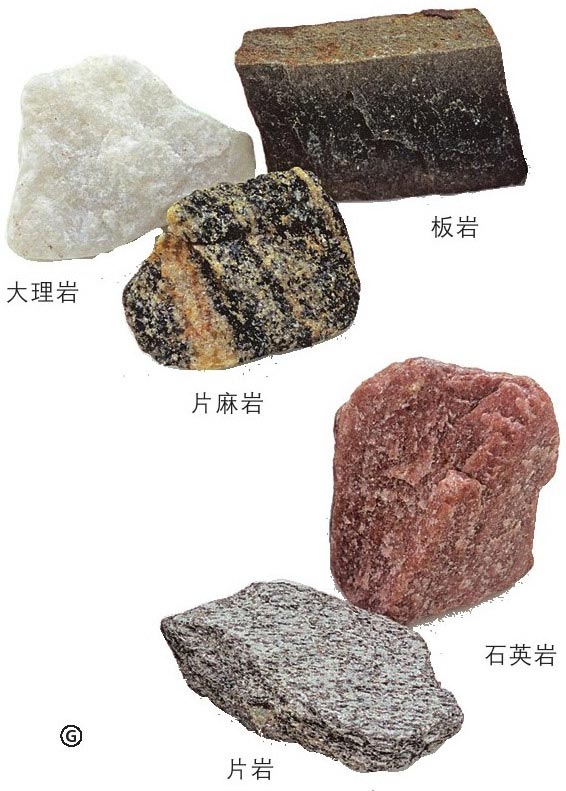
Over tens of millions or even hundreds of millions of years, igneous rocks and sedimentary rocks will inevitably be affected by various geological processes. Temperature, pressure and fluids in the earth's crust may cause various physical or chemical reactions in these pre-existing rocks, causing changes in their composition, structure and structure and producing new minerals. This process occurs mainly in the solid state of the rock. People call these rocks metamorphic rocks.
The three major rock types have obvious differences, but are also related to each other and can transform into each other. Pre-existing metamorphic rocks, igneous rocks and sedimentary rocks can enter deep inside the earth under geological processes, melt or partially melt under high temperatures to form magma, and the magma consolidates to form new igneous rocks; Pre-existing igneous rocks, sedimentary rocks and metamorphic rocks are exposed to the surface and can form new sedimentary rocks through erosion, mechanical crushing, transportation and deposition; Pre-existing igneous rocks and sedimentary rocks can be transformed into new metamorphic rocks under the metamorphism of high temperatures, high pressure and stress. In the vast space and space, the three major rock types form a interlocking circular chain.