
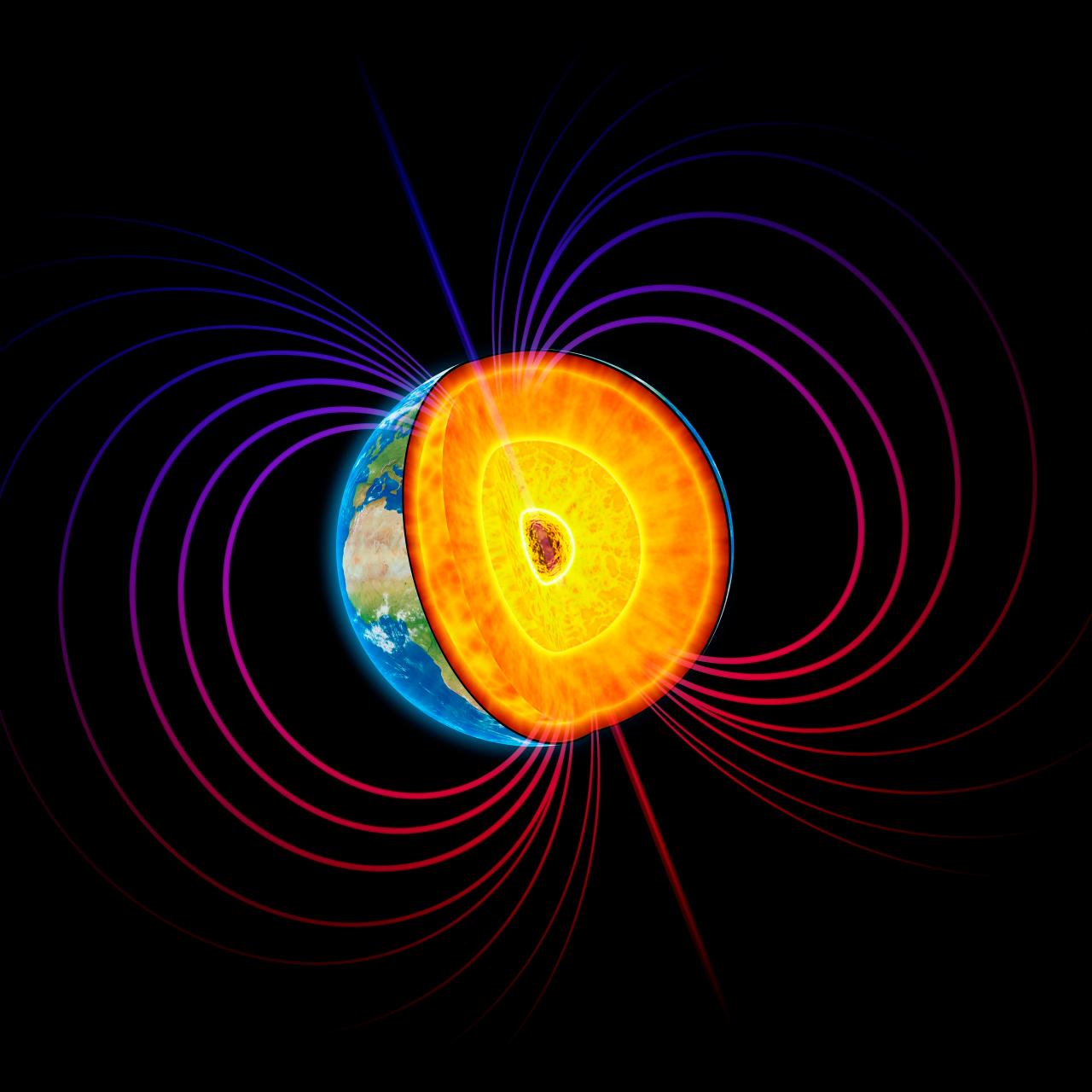
The existence of a magnetic field is one of the important attributes of the earth. As early as the early 17th century, people already knew that there was a huge magnetic field on the earth. People have also begun to use magnetic fields very early, such as the compass invented in ancient China.
Regarding the generation of the Earth's magnetic field, there was a myth that it came from the North Star in ancient times. With the development of modern science and technology, people have increased their observations of the Earth's magnetic field, and their research on the Earth's structure has continued to deepen. Many theories have emerged to try to explain the generation of the Earth's magnetic field, but there is no final conclusion. Some people think that there is a huge permanent magnet inside the earth and causes the earth's magnetic field to be generated; some people think that there is a huge current inside the earth, which leads to the formation of a strong electromagnetic field; others believe that the heat generated by radioactive materials inside the earth causes the temperature difference inside the earth, thereby generating Electric current and forming a magnetic field; in addition, theories about the earth's magnetic field include gyromagnetic effect, Hall effect, electromagnetic induction, etc. But none of these hypotheses can fully explain the existence of the Earth's magnetic field.
The "generator theory" developed in the 1940s has so far been able to roughly explain various known characteristics of the Earth's magnetic field. More evidence has been obtained in observations, experiments and theoretical research, and has received more and more support from people. This is also the theory of the Earth's magnetic field that is currently studied and applied. The generator theory holds that the conductive liquid inside the earth produces a steady current when it flows, and the effect of this current forms the earth's magnetic field. Since the 1990s, geophysicists have used calculations and simulations to prove that when the earth's inner core rotates faster than the liquid outer core, a relatively stable magnetic field can be formed over thousands of years, and after a certain period of time, its polarity can be reversed. However, the earth's internal structure is complex and there are many factors affecting the earth's magnetic field, so this hypothesis still requires further observation and experimental research. Moreover, this hypothesis has two difficulties: first, where does the energy of the magnetofluid "generator" come from; second, this hypothesis requires an initial magnetic field, and how is the initial magnetic field formed? These have become major unresolved geophysical problems.