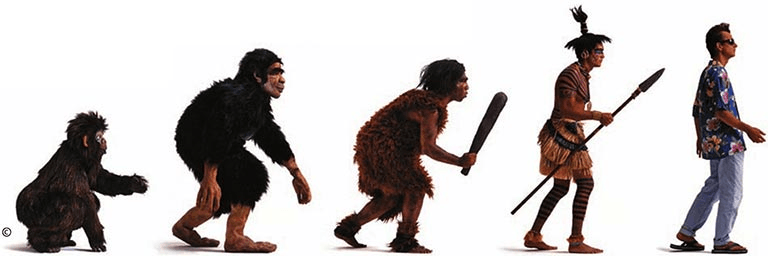
How humans evolved How did apes with bulging skulls and protruding faces become modern humans? This question has been debated for hundreds of years, and to this day there is no convincing and perfect answer. However, most scientists agree with Darwin's theory of evolution, believing that all living things gradually evolved from their ancestors, and the ancestors of modern humans were Australopithecus. Among the top ten scientific advances in 2011 selected by the American magazine Science, one was the new discovery made by scientists from many countries studying Australopithecus, which was believed to be the best species of the ancestor of the genus Homo. People are the highest form of animals. They can walk upright, have a large head, use language to communicate, make tools, and have consciousness and social nature. Based on fossil data, scientists believe that ancient apes evolved into Australopithecus about 4 million years ago, Homo Hominis appeared 2.5 million years ago, Homo erectus (Homo sapiens) 2 million to 250,000 years ago, Homo sapiens 250,000 years ago. It was not until more than 100,000 years ago that modern humans appeared. In addition to the obvious differences in the skull and face shape from modern humans, the cranial volume of early Homo sapiens was very close, with an average of about 1440 ml. By more than 100,000 years ago, late Homo sapiens and modern humans were already difficult to distinguish. During evolution, the differences in cranium from ape to human have become greater and greater, making the cranium larger and larger. The hypothesis of evolutionary biologist Mayer and zoologist Kinden holds that between 7 million and 5 million years ago, due to the dry climate and dead trees, the forest area on the earth continued to shrink, and ancient apes who have made forests their home for generations faced The danger of breaking their homes. In order to reproduce, these ancient apes, who could flexibly climb and forage in the forest, had to find another way out. In addition to forests, grasslands are also ideal resting places. However, when ancient apes first arrived, they were just outsiders on the grassland. It turned out that the large animals such as elephants and bison that inhabit there did not welcome these uninvited guests. Once they met on narrow roads, the ancient ape could only escape. Those who couldn't escape in time would either die or be injured. In addition to elephants and bison, there are also fierce carnivores such as lions, tigers, leopards, and wolves on the grassland. When they see this group of strange visitors from the forest, they will open their bloody mouths and pounce over. The ancient ape would die in an instant. In addition to leaving a pool of blood, the bones and meat would become a delicious meal for the ferocious beast. On this prairie, which is surrounded by dangerous signs and is always in danger, if the ancient ape could stand up, look around, observe the enemy's situation, and make preparations for escape early, he could survive in danger. Therefore, in this life-and-death environment, those who survived were of course those ancient apes who could look upright, and their forelimbs must be shorter than their hind limbs. These apes continued to reproduce and became an upright walking population. This was Australopithecus. Australopithecus walking upright no longer had to walk on all fours, and its hands were freed. In addition to predation and self-defense, the free hands were used to take care of infants and young children. When encountering natural enemies, they could also carry the children and escape. According to research on the development of the human brain and the ape brain, it can be known that the human brain and the ape brain have a large difference in cranial volume. The human brain is larger than the ape brain, so humans are smarter than apes. However, the ape brain develops significantly faster than the human brain. The brain of the newborn infant ape is basically fully developed. Otherwise, the infant ape will not be able to actively survive or seize the mother. Babies that have just left their mother have no ability to survive except for chirping and crying. If they are not taken care of, they will only die. Australopithecus, who walked upright, could actively use their free hands to take care of their descendants, which was conducive to reproduction, and thus evolved into Homo Hominis and Homo erectus (apes) with larger cranial volumes.
How humans evolved?
There has been controversy over the evolution of humans for hundreds of years. Most scientists agree with Darwin's theory of evolution and believe that the ancestors of modern humans were Australopithecus, which is the best species in the genus Homo studied by scientists from many countries. Human evolution has gone through stages such as Australopithecus and Homo habilis, and adapting to the grassland environment such as upright walking has promoted evolution.