
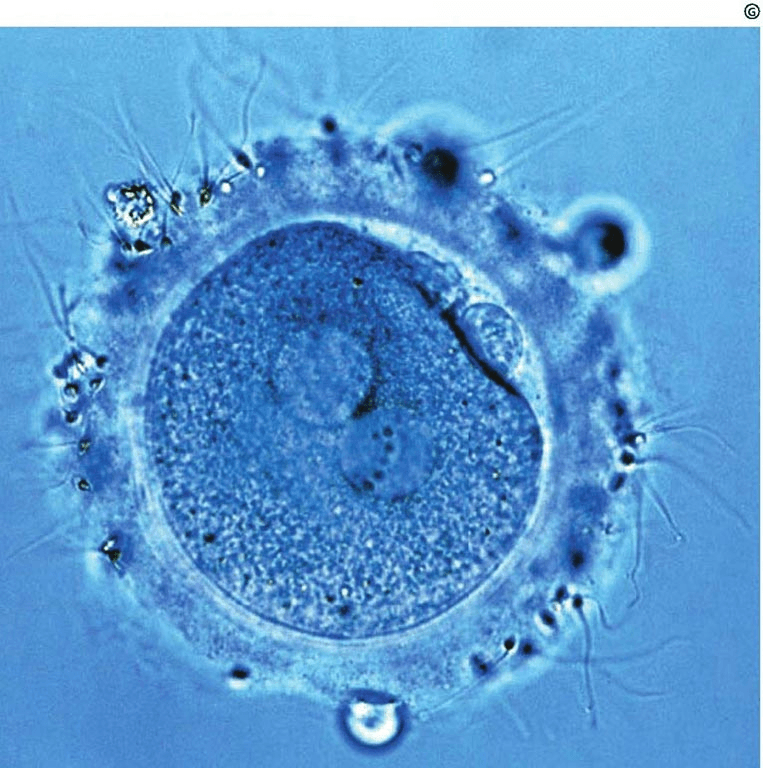
The world of life is magnificent and colorful, and life phenomena are fascinating! The ancestors of humans were ancient apes who made the forest their home. Where did ancient apes come from? Many people will be curious about such issues. When it comes to human beings themselves, a newborn baby is a piece of meat that falls from its mother. This piece of meat was initially just a "little thing" that was not visible to the naked eye in the mother's body. The real name of this little thing is "fertilized egg." The fertilized egg grows day and night in the mother's abdomen, and eventually leaves the mother to live independently. The days of a fertilized egg in its mother's womb are really changing and wonderfully. A fertilized egg proliferates to trillions of cells in less than a year. The trillions of cells from the same fertilized egg contain a variety of cells. There are skin cells, nerve cells, white blood cells, etc. in the same person, and there are no less than 200 types of cells. How can a fertilized egg reproduce trillions of cells? How can there be a variety of cells with very different shapes, sizes, and functions among these trillions of cells? Do you want to know the secret?
Sperms gather around the egg. When the first sperm breaks through the zona pellucida and combines with the egg, a fertilized egg is about to be formed. A fertilized egg can become a person, so it is not an exaggeration to call a fertilized egg a "totipotent cell." So can various cells such as skin cells and muscle cells that proliferate from a fertilized egg become "totipotent cells" like the "fertilized egg"? If skin cells, muscle cells, etc. can become "totipotent cells" like "fertilized eggs," then if a person has a problem with an organ, such as kidney, heart, lungs, etc., skin, muscle and other cells can be used to rebuild a normal kidney, heart, and lungs. What a tempting topic is to replace defective organs with reconstructed normal organs so that people on the verge of death can live and work healthily again!
Those who answered this question were British biologist Gordon, who won the 2012 Nobel Prize in Physiology and Medicine, and Japanese scholar Nobu Yamanaka. In 1962, Gordon replaced the nucleus of a toad egg with a nucleus from the intestine of the African Xenopus, developing a lively toad, creating a precedent in the history of animal reproduction; while Nobu Yamanaka put several genes into the skin cells of mice and induced it to become pluripotent stem cells that can develop into various tissues, called iPS cells. China scientists used mouse iPS cells to create a reproductive mouse "Xiaoxiao", confirming that iPS cells are totipotent cells. The birth of "Xiaoxiao" and his younger brothers shows that the myth of Sun Wukong plucked his fur and transformed into a monkey has become reality, and the life science that turned the myth into reality is so magical!
With the development of human society, environmental problems have followed one after another. For a long time, human beings have been working hand in hand with nature and enjoying the fun given by nature's infinite resources. However, when science and technology developed rapidly and humans discovered that the tools they had were getting stronger and stronger, humans, who originally feared nature, began to try to transform and rule nature. A series of crises also occurred: Crises such as food, energy, environment and health followed one after another. This series of crises awakened humans, who once thought they were the spirit of all things and the masters of nature, and finally realized that in nature, diverse organisms are in an invisible network, and humans and other organisms, organisms and the environment are all interdependent. Human beings are by no means the masters and conquers of nature, but can only be the managers of nature. This is the conclusion of life science.
Sorghum and beets turn into wine, wine turns into vinegar, and vinegar loses its sour taste. Do you know why? Why would the plague sweep the world like a black demon and kill thousands of people? Life science tells us that turning sorghum and sugar beets into wine is a gift dedicated to mankind by a small life invisible to the naked eye, and plague is another kind of little demon at work. How to treat those little lives who silently contribute to mankind and how to eliminate these little demons are all life topics that we need to study seriously.
Black cows give birth to white calves, but the descendants of red peas still bloom. This is a biological variation and inheritance phenomenon. Since Mendel revealed the laws of variation and inheritance in organisms, inheritance and variation have formed an indissoluble bond with "genes." We study the inheritance and mutation laws of organisms, and the genes of living objects. This is the need for adequate food and clothing, as well as for health and longevity.
Genes are composed of DNA (deoxyribonucleic acid) molecules. Since the structure of DNA was revealed, life sciences have developed rapidly. Therefore, natural scientists in many different fields have unanimously predicted that the 21st century will be the century of life sciences. Since the 20th century, due to the participation of natural scientists in the fields of physics, chemistry, mathematics and other fields in life sciences, good news has been reported frequently in many fields such as gene diagnosis, gene therapy, gene chips, and epigenetics. Genetic engineering also came into being, and many drugs produced by genetic engineering have been used in clinical practice and achieved good results. Although there are still different opinions in the fields of genetically modified animals, genetically modified plants, genetically modified foods, etc.,"genetically modified" is after all the inevitable development of science. Science itself is a double-edged sword, and humans will never throw away the sword just because it can be used to kill people. We should take its benefits and abandon its harm.
Humans use microbial fermentation to make wine. On June 26, 2000, 16 centers in the United States, Britain, Japan, France, Germany and China jointly announced that the "working framework map" of the human genome had been drawn, marking another milestone achievement in the history of life sciences. To this end, Clinton, the then White House owner, said that this was "a day that will last forever." Just as scientists around the world are rejoicing at the drawing of the "working framework" of the genome, new problems have emerged. For example: It was originally thought that there should be at least 100,000 genes in the human genome, because there are at least 100,000 proteins in the human body, but less than 30,000 genes have actually been recognized in the human genome; there are about 3 billion base pairs (deoxyribonucleotide pairs) in the human genome, but 3% to 5% of the DNA sequence of the human genome are related to protein structure, and a considerable part of the genomic DNA sequence is repetitive sequences. People are looking forward to one day discovering all the laws of life. The drawing of the "working framework" of the genome is only the first step in the long march. The post-genome era will give scientists a more arduous and glorious mission. Research in life sciences still has a long way to go!