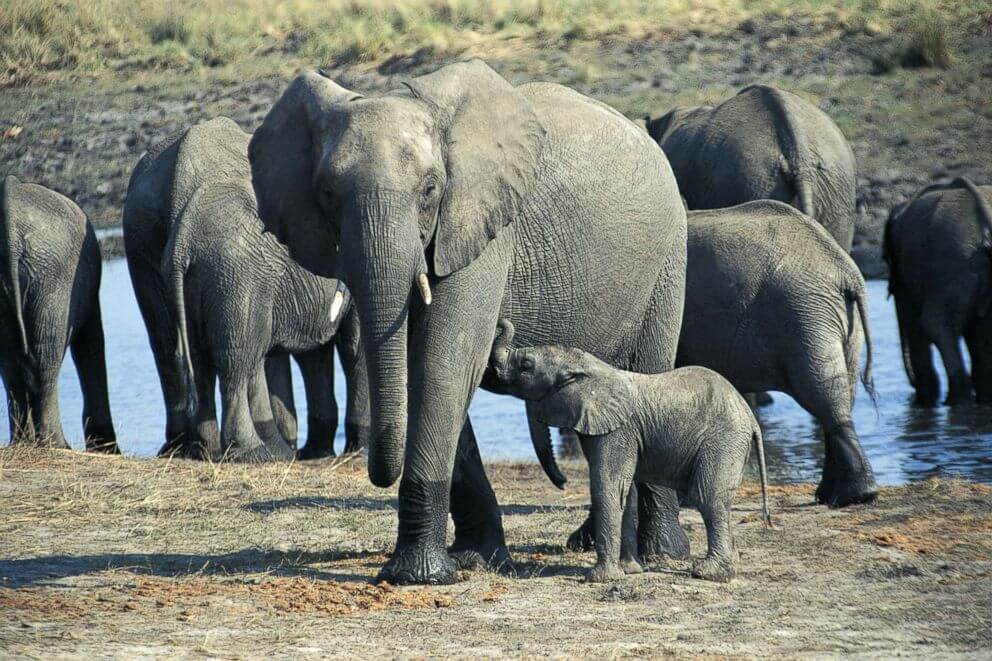
The scope of life is huge! For example: big trees and grass, one tall and the other short; elephants that make their home in the jungle and whales that live in the waters are both very large, but elephants have long noses, big ears and four thick legs. Whales not only have no legs, ears and noses, but there are one or two holes on their huge heads, which are the whale's noses; also, lively monkeys and bacteria that are invisible to the naked eye are all living creatures. Although they are very different in size and lifespan, they are all living objects. All living things can reproduce. How do we know that living things are living objects? Just look at the similarities between them to draw conclusions. All living objects have a cellular structure. A bacterium has only one cell, while a person has 10^12 to 10^14 cells. All living objects transform nutrients in food into their own components and store energy in material transformation. This process is called assimilation; living objects also decompose their own components during their own growth and development. At the same time, energy is released. This process is called alienation; assimilation and alienation are collectively called metabolism. All living objects can produce descendants under normal circumstances. This is called reproduction. In addition to many similarities between the upper and lower generations, there are also differences between all living objects. Black cows can give birth to white calves, and flower dogs can give birth to white or black calves. This situation that the previous generation and the next generation are the same is called inheritance, and the differences between the next generation are mutations. All objects with life are in harmony with the environment. Different organisms live in different environments. If organisms cannot keep up with the pace of environmental changes, there will only be a dead end. In other words, organisms in the living environment are in the competition of "survival of the fittest and elimination of the unfittest". From what organisms have in common, we can understand life in this way, that is, it has a cellular structure, has metabolism, inheritance, genetic variation and adaptation to the environment. Life is one of the most surprising and charming natural phenomena in nature. People's understanding of life begins with specific living objects (i.e. living things). Today, different biologists have conducted quite detailed research on animals, plants, and microorganisms, and there is also quite abundant information on life activities. However, since organisms are the most complex systems in nature, and life is uncertain, restricted and limited, although studying life is the most meaningful thing, with the knowledge people currently possess, it is far from truly understanding the nature of life. There is still a considerable gap, and it is still difficult to give a universally recognized and precise definition of life. Cells are like the "building blocks" that make up life, and what's inside cells has puzzled people for a long time.
what is life?
Life covers all types of organisms of wide sizes. Life has characteristics such as cell structure, metabolism, reproduction, genetic variation, and adaptation to the environment. Although the research results are quite fruitful, due to the complexity of organisms, there is no recognized definition of life. It is also mentioned that cells are the basic building blocks of life.