
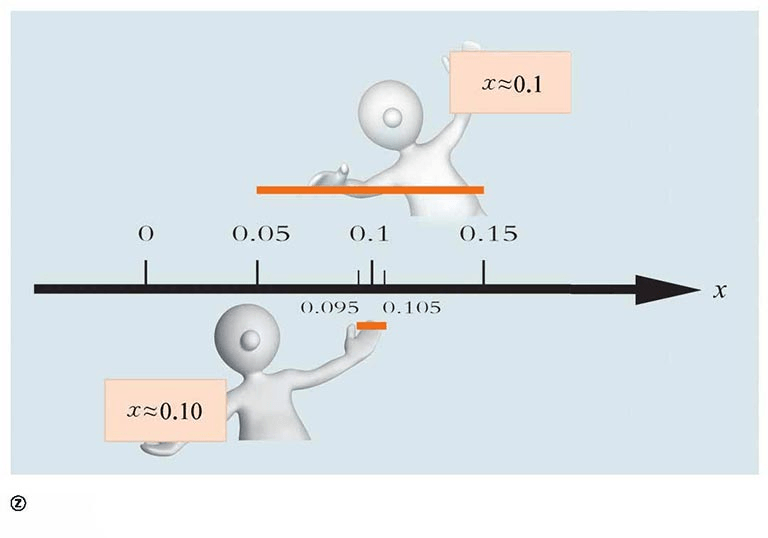
Is 0.1 the same as 0.10?
When we only learn about exact decimal numbers, we might think this question is redundant. For example, 0.1 = 1/10, 0.10 = 10/100. But if we simplify the fraction 10/100, it becomes 1/10. So the values of the two numbers are exactly the same. Generally, we think that writing 0.10 is not the most simplified form of a decimal number, so we consider the last zero unnecessary.
However, when we learn about approximate decimal numbers, the situation is different. Approximate decimal numbers actually represent a range of values. To make our approximate decimal numbers as accurate as possible, we require this value range to be as small as possible. When rounding to the nearest value, the decimal number 0.1 might be obtained by rounding up 0.05 to 0.1, or by rounding down 0.14 to 0.1. Therefore, the approximate decimal number 0.1 represents a value between 0.05 and 0.15. If we use x to represent its exact value, then 0.05≤x<0.15. What about 0.10? This approximate decimal number might be obtained by rounding up 0.095 to 0.10, or by rounding down 0.1049 to 0.10. If we use x to represent its exact value, then 0.095≤x<0.105, which is a much smaller range than 0.1. Looking at the number line, it's clear that 0.10 represents a smaller value range, while 0.1 represents a larger value range. Therefore, as approximate decimal numbers, 0.1 and 0.10 are different.
When dealing with exact decimal numbers, we should write 0.10 as 0.1, with the last 0 being redundant. But when dealing with approximate decimal numbers, we must not remove the last 0 of 0.10. This 0 is very important. In financial accounting, units are usually in yuan, with cents and fractions expressed in decimal form, and the decimal point is not removed. For example, 10 yuan and 1 cent are written as 10.10 yuan, and we must not remove the last 0 and write it as 10.1 yuan.