
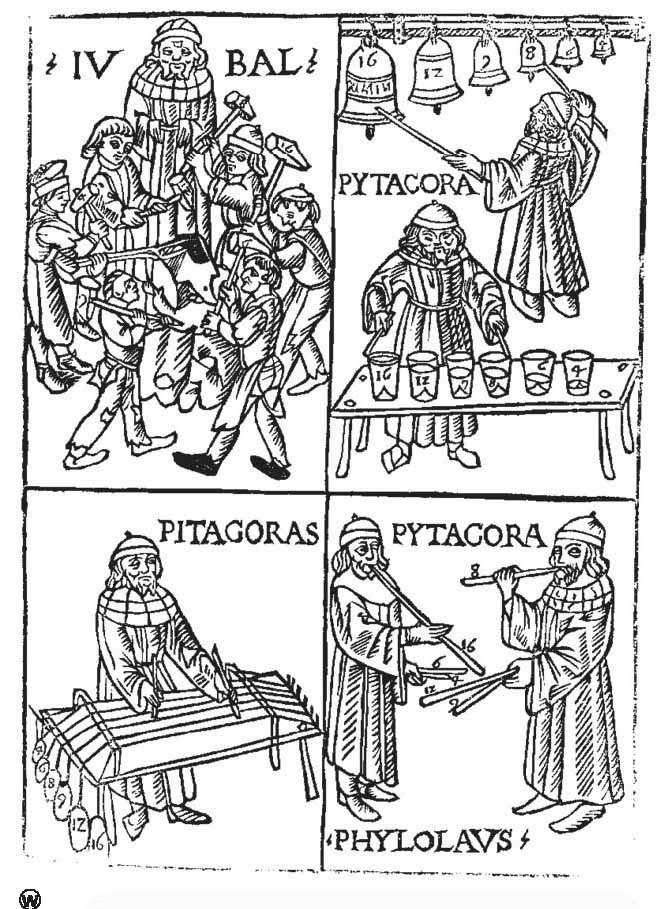
One day in the 6th century BC, the Greek mathematician Pythagoras walked past a blacksmith's shop and heard the pleasant sound of hammers hitting iron. He went into the shop to analyze the hammers and realized that those with harmonious tones shared a simple mathematical relationship—their weights were in simple ratios to each other. Specifically, hammers whose weights were equal to half, one-third, or one-fourth of another hammer could produce harmonious sounds. On the other hand, hammers that always produced a noisy sound when struck together with others did not share such a simple integer ratio with other hammers. Pythagoras repeated this experiment on string instruments and reached the same conclusion: when the length of two strings is in a simple integer ratio, the strings can produce more pleasant tones. It turned out that the harmony of tones was determined by the ratio of integers! This discovery from music greatly inspired Pythagoras. Later, he attributed the motion of planets to integer ratios. Based on these findings, Pythagoras declared: "Everything is number," meaning that the entire world could be explained by integers or their ratios. This became the creed of his Pythagorean School. Their concept in geometry was that any two line segments are commensurable. Here, let's explain this unfamiliar concept. If two line segments are of lengths a and b, and a can be divided into d, an integer multiple of n times, and b can be divided into d, an integer multiple of m times, then the line segments a and b are said to be commensurable (d being the common unit of measurement for both). In other words, the ratio of the lengths of any two line segments is an integer or a fraction.
This highly intuitive and commonsense conclusion seemed indisputable and was widely accepted by the ancient Greeks at the time. The turning point began after Pythagoras proved the Pythagorean theorem. One of Pythagoras's students, Hippasus, while studying his teacher's famous work, wondered: Are the diagonal and side of a square commensurable? After careful consideration, Hippasus unexpectedly found that the two line segments did not share a common unit of measurement: no matter how small the unit was chosen, it could never become a common unit of measurement for the side and diagonal of a square. In other words, the side and diagonal of a square are incommensurable! Or, the ratio of the diagonal of a square to its side (which we are familiar with) is neither an integer nor a fraction, but a completely new number that people at the time did not understand. This discovery was utterly devastating to Pythagoras and his school, completely overturning their mathematical and philosophical beliefs. According to legend, Hippasus was drowned by Pythagoras's followers for leaking the discovery.
After Hippasus, many numbers like were discovered. Later, such numbers were collectively called "irrational numbers," while the originally accepted numbers (integers or their ratios) were called "rational numbers." In ancient Greek, the terms "rational" and "irrational" originally meant "commensurable" and "incommensurable." During the later translation process, in addition to the original meaning of "commensurable," the connotations of "rational" and "irrational" were derived. Later, in Chinese translation, they were translated as "rational numbers" and "irrational numbers," and most people no longer know that their original meaning was "commensurable" and "incommensurable."