
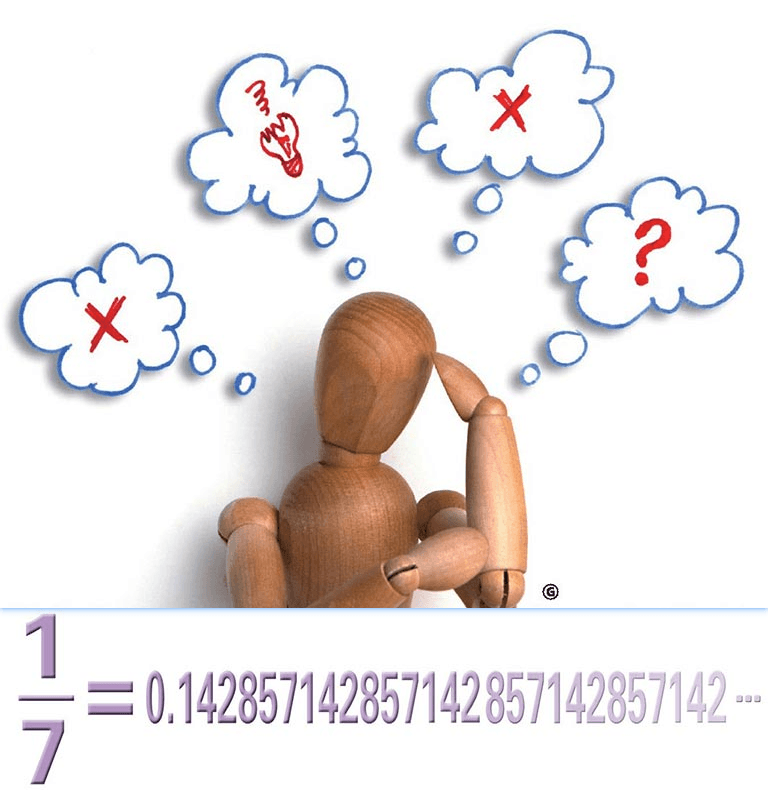
Numbers (including integers) are rational numbers. From the perspective of decimals, they are either finite decimals or infinite recurring decimals. This means that fractions and finite decimals or infinite recurring decimals can be converted into each other. Why is this the case? The value of a fraction is obtained by dividing q by p. When dividing q by p, the remainder can only be 0, 1, 2, ..., p-1 in each iteration. If the remainder is 0, the quotient will be a finite decimal; if the remainder is always non-zero, there can only be p-1 possible remainders. According to the principle of pigeonhole, there must be two identical remainders among the p decimal places of the quotient. Therefore, the quotient will inevitably recur after these repeated remainders, meaning that the quotient is an infinite recurring decimal, and its first "recurring cycle" must begin within the first p decimal places. Thus, fractions can be converted into finite decimals or infinite recurring decimals.
Conversely, finite decimals or infinite recurring decimals can also be transformed into fractions. Converting a finite decimal into a fraction is simple: for a rational number with n decimal places, simply multiply it by 10^n and divide by 10^n. For an infinite recurring decimal, first multiply it by 10^(n+m) and 10^n, where n is the number of non-recurring decimal places and m is the number of recurring cycles. The decimal parts of these two expanded numbers will be exactly the same, and subtracting them will yield an integer. Thus, the original decimal can be converted into a fraction. For example, for a=0.24126126126..., the first two decimal places 24 are non-recurring, and the recurring cycle is 126 with three digits. Calculating 100000a=24126.126126... and 100a=24.126126..., the difference is (100000a-100a)=24126-24=24102. Therefore, we have converted the infinite recurring decimal a into a fraction.