
Since the introduction of the imaginary unit i = , mathematicians have increasingly used complex numbers to solve mathematical problems. However, initially, mathematicians did not recognize complex numbers as real numbers, considering them as illusory and imaginary concepts. The great mathematician Euler made significant contributions to the study of complex numbers. He introduced the name "imaginary number" and the symbol i for the imaginary unit, and also derived the famous Euler's formula e iθ^ = cosθ + isinθ. However, Euler himself did not acknowledge the reality of complex numbers. He said: "All numbers of the form and are impossible, because they represent the square root of a negative number. For such numbers, we can only assert that they are neither nothing, nor more than nothing, nor less than nothing. They are purely fictional." This situation persisted for nearly 200 years until the era of Gauss in the 19th century brought it to an end.
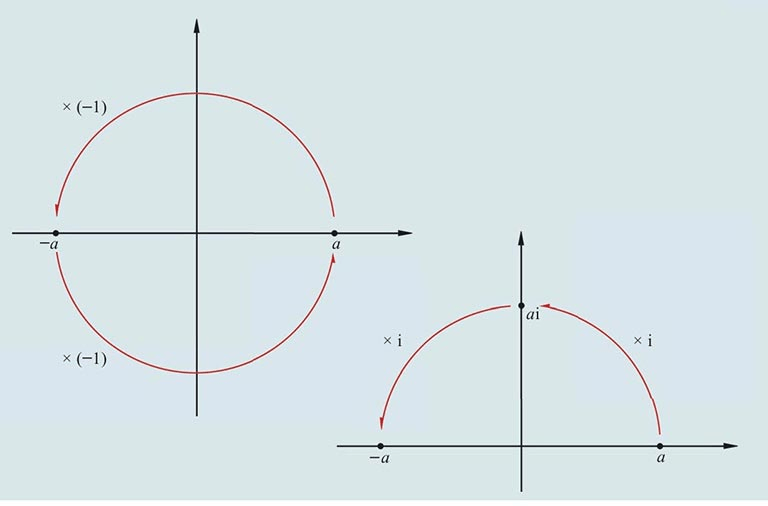
We know that real numbers can be represented by a point on the number axis. So how should we represent the imaginary number i? At that time, several European mathematicians such as Wessel, Argand, and Gauss noticed that multiplying a number by -1 equals its opposite, which is equivalent to rotating 180° around the origin O on the number axis. Multiplying it by -1 again means rotating back to the original position. Now i^2 = -1, indicating that multiplying a number by i twice is equivalent to rotating 180° around the origin. Therefore, multiplying it by i once should be equivalent to rotating 90° (counterclockwise). It can be imagined that all purely imaginary numbers should lie on a line perpendicular to the real number axis passing through the origin, which is the imaginary axis. The original real number axis is called the real axis, and the real and imaginary axes together form a plane Cartesian coordinate system, where a + bi represents a point (a, b) on this rectangular coordinate plane. The plane represented by complex numbers is called the complex plane.
This method endows complex numbers and their addition, subtraction, multiplication, and division operations with clear geometric meanings. From then on, complex numbers had a practical model, and people gained a sense of reality for them. The originally illusory complex numbers became tangible things. This model not only brought realism to complex numbers and eliminated people's doubts, but also connected complex numbers with plane geometry and vector operations, enabling many mathematical and physical problems on the plane to be solved using the tools of complex numbers. In the 19th century, a discipline called complex analysis was developed on this basis, which was an extension of calculus to functions of complex variables. Complex analysis has important applications in fluid mechanics and elasticity, such as the use of conformal mappings in wing design. More surprisingly, complex analysis has also been used to study the distribution of prime numbers and developed into an important branch of modern mathematics - analytic number theory. In contemporary mathematics, whether it's pure mathematics or applied mathematics, complex numbers are indispensable. People in the past could never have imagined that these "purely fictional" numbers would be so powerful today.