
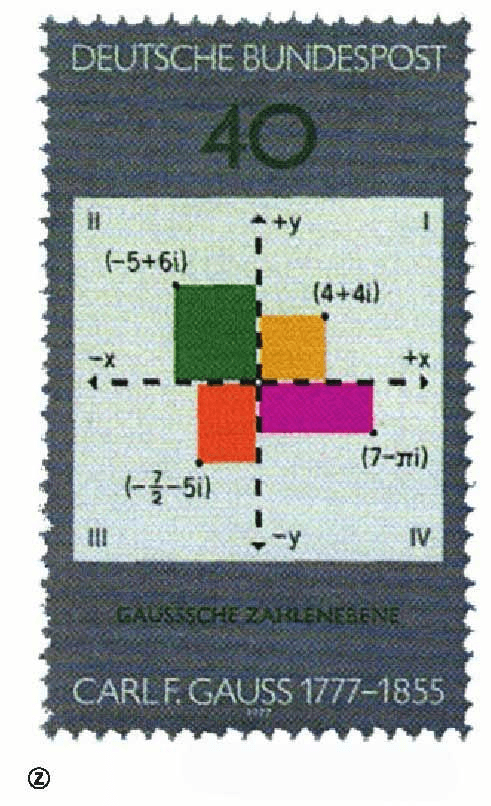
As we all know, numbers in the form of a + b i are called complex numbers, where a and b are real numbers, and i represents a number that is very different from the real numbers we usually recognize, and it seems that we can't encounter such numbers in our real world. So why do we have to introduce such numbers? Middle school math textbooks have already told us that when we solve a quadratic equation ax 2 + bx + c = 0, if ∆ = b 2 -4ac < 0, then the equation has a pair of conjugate complex roots. Indeed, the introduction of complex numbers makes it possible to have roots when ∆ < 0, but at this time, if the equation has no roots in the real number range, it may be more in line with reality, and it seems unnecessary to artificially introduce invisible and intangible complex roots.
Historically, complex numbers were introduced by Italian mathematician Cardano in the 16th century. His main purpose of introducing complex numbers was to solve cubic algebraic equations. To illustrate this, let's consider the cubic equation x 3 -7x + 6 = 0. It can be easily verified that the equation has three real roots: x = 1, x = 2, and x = -3. Since a cubic equation can have at most three different roots, these three roots are the only roots of the equation. At that time, Cardano already knew that the root-finding formula for cubic equations of the form x 3 + px + q = 0 is now. Applying the root-finding formula to the equation x(^3) -7x + 6 = 0, where p = -7 and q = 6, in the above formula, we must deal with such numbers in order to ultimately obtain three real roots. Cardano noticed that when ∆ < 0, in order to find the roots of a cubic equation (even if they are real), people cannot avoid the operation of taking the square root of a negative number, and they have to deal with the new numbers generated by taking the square root of a negative number, such as the ones mentioned above. Cardano introduced a new class of numbers into mathematics, which is what we call complex numbers today. At that time, people uniformly wrote such numbers in the form where a and b are real numbers. Later, Euler suggested using i to replace them, and thus we have today's representation of complex numbers: a + b i.
After the introduction of complex numbers into mathematics, they not only "never left" but also expanded their use. Complex numbers are not only used to solve cubic or quartic equations, but also in the calculation of trigonometric functions. The famous De Moivre's formula is an example. By taking n = 2 and n = 3, we can obtain the sine and cosine formulae for double and triple angles, and from this, we can also obtain the formulae for n times the angle. There are many problems in the real number field that can be solved simply or ingeniously through the complex number field. To this end, French mathematician Adama made a very apt comment: The shortest path between two truths in the real number field is through the complex number field.