
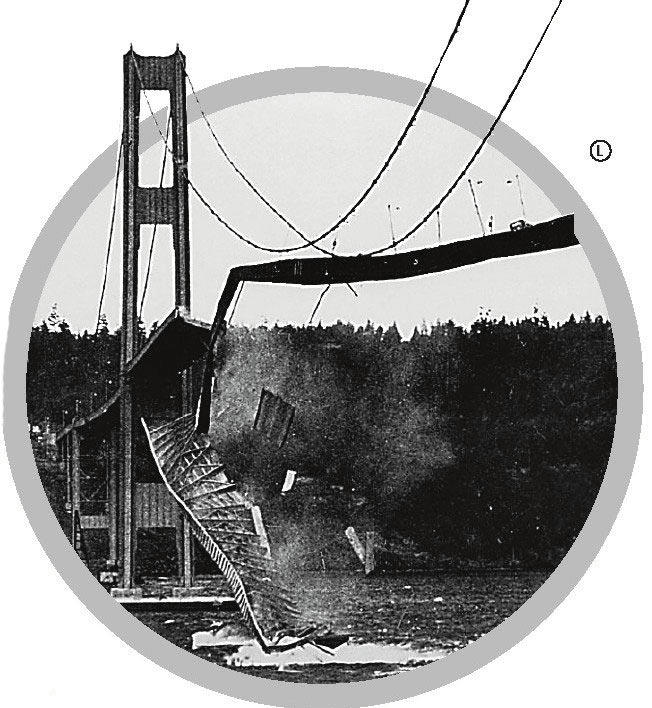
The Tacoma Narrows Bridge, located in Washington state in the northwestern United States, spans the Tacoma Narrows. This 853-meter-long suspension bridge was completed and opened to traffic on July 1, 1940. Even at the time of its construction, it exhibited a tendency to sway in the wind, a phenomenon clearly felt by drivers. Locals nicknamed it "The Dancing Getty." On November 7th of that year, the bridge collapsed due to severe swaying, fortunately without fatalities. At the time, the world-renowned aerodynamicist and director of the Guggenheim Aeronautical Laboratory, Theodore von Kármán, was a member of the accident investigation team. Through wind tunnel experiments at Caltech, he proved that the cause of the steel-framed bridge's collapse was actually wind speeds of less than 20 meters per second!
Aerodynamic studies have shown that when wind blows across a bridge, within a certain wind speed range, the airflow passing over the bridge periodically generates two sets of parallel, counter-current vortices, the so-called "Kármán vortex street." When each vortex separates from the surface of the object it circulates, the object experiences a force. The continuous appearance of vortices exerts a periodic force on the bridge. When the frequency of this force approaches the natural frequency of the bridge's vibration, resonance occurs. At this point, the bridge's swaying amplitude increases, eventually leading to its collapse. This serious accident made bridge engineering recognize the importance of aerodynamics in structural design, and since then, all bridge and super high-rise building designs must undergo safety verification through wind tunnel model experiments.
A similar situation can occur when a large contingent of people marches across a bridge in unison. If the frequency of the same periodic force generated by the synchronized marching is close to or equal to the natural frequency of the bridge's vibration, the bridge can also collapse due to resonance. In 1905, a Russian Empire army caused the tragic collapse of the Fontanka River Bridge near St. Petersburg while marching in unison.
Another common example in life is that if the frequency of a swing's swing is the same as the frequency of the force applied by the person swinging on it, the swing will swing higher and higher; otherwise, it will be difficult for the swing to swing very high.