
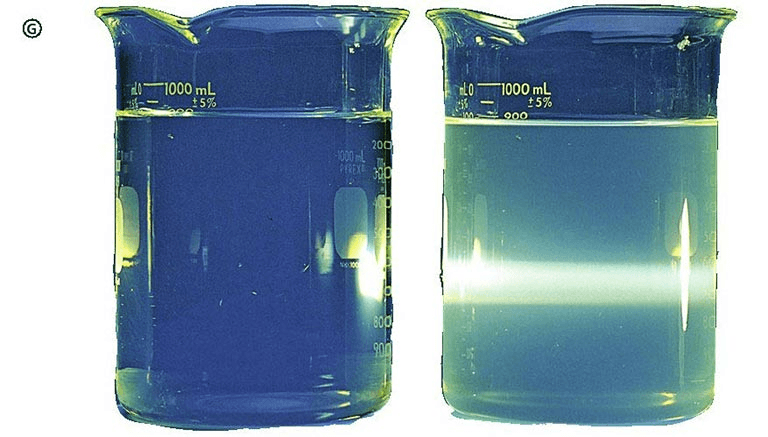
Why does a bright path appear when light passes through milk? When you poured a glass of milk and were ready to drink it, did you think that you could do an interesting physics experiment with this glass of milk? The experiment is simple: dilute the cup of milk first, and then illuminate the cup of milk with light from a laser pointer. At this time, you will notice that a bright path has appeared in the milk. To study this phenomenon further, you can try shining light on a glass of pure tap water, and you will find that there is no light path in the water. Diluted milk is not very transparent. Why does a light path appear? On the contrary, tap water is very transparent, so why can't the light path be seen? This is actually the Tyndahl phenomenon, which was first successfully explained by the British physicist Tyndahl.
Milk consists of water and solid particles, which are mainly fat and protein molecules. When light passes through milk, it will scatter on the surface of the particles. At this time, solid particles are like luminous bodies. As a result of countless particles scattering light, a bright light path. And the higher the concentration of the particles, the stronger the scattering effect on light, and the brighter the light path you see will be. For water molecules, it scatters light much less, so we cannot observe the light path in the water. It is worth mentioning that the concentration of particles in milk should not be too large. If you directly use undiluted milk to do the same experiment, most of the incident light will be absorbed or reflected, and the bright light path will not be observed. This system in which Tyndall's phenomenon occurs is called a colloid, and the diameter of the particles in the colloid is generally between tens of nanometers and a few microns.
If you pay attention, you can often see the Tyndall phenomenon in life. For example, the laser beam shot out in the night sky of a city. We can clearly see its propagation path. This is actually the result of the beam being scattered by countless suspended dust in the air. It is conceivable that when the concentration of floating dust in the air is small, it will be difficult for us to see this beam. Isn't this a way to judge the quality of the air?