
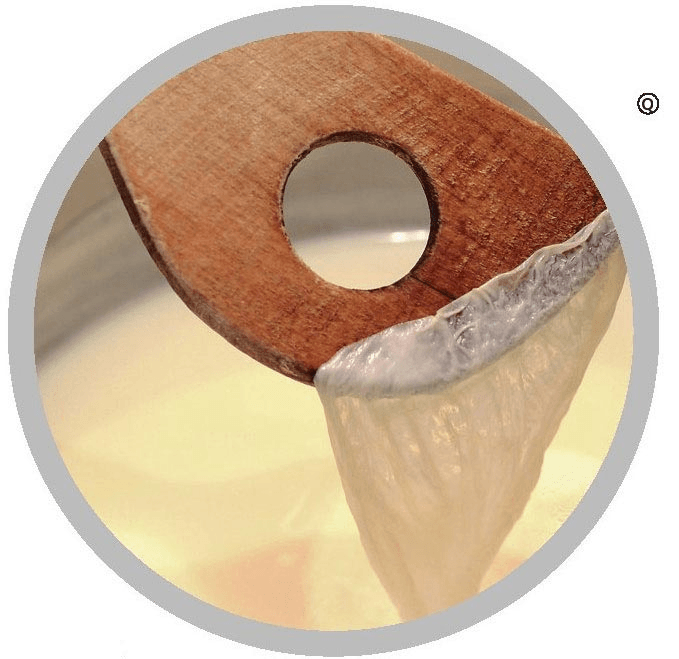
Why does a thin layer of skin appear on the milk? Milk is a very popular drink. It is rich in nutrients. In addition to sufficient water, milk also contains nutrients such as protein, fat, lactose, and vitamins. In daily life, we often find an interesting phenomenon, that is, a thin layer of skin will appear on the surface of milk after heating and cooling. Why is this?
This layer of "skin" is caused by the floating of fat and protein in milk. Milk contains a variety of nutrients, which dissolve or uniformly disperse in water at room temperature to form a stable system. But after milk products are processed, an enzyme called lipase remains in them. During milk storage, these lipases break down fat globule membrane proteins (a protein) in milk, releasing free fat globule. Since the density of fat globules is lower than that of water and the density of protein is higher than that of water, this decomposition will cause the fat globules to float up, and the remaining fat globules membrane proteins on the globules will also float up. When producing milk products, factories will adopt a method called homogenization processing to inhibit the floating of fat globules. Simply put, it is to homogenize and granulate the fat globules in milk, so that each fat globule is covered by relatively More protein. Therefore, this phenomenon is not obvious at room temperature.
After the milk is heated, the situation is different. When a liquid flows, friction occurs between its molecules. The macro manifestation of this friction is the viscosity of the liquid, and its strength can be characterized by the viscosity coefficient. When the temperature of the liquid increases, the motion of the liquid molecules intensifies, and its viscosity coefficient decreases accordingly. Therefore, after heating the milk, while the above-mentioned decomposition reaction accelerates, the viscosity coefficient of the milk also decreases. At the same time, the floating resistance of the fat globules also decreases accordingly, which results in some fat globules in the milk. The remaining protein on the globules and the balls will quickly accumulate on the surface of the milk. Because there is a temperature difference between the surface of hot milk and the air, the moisture on the surface will quickly evaporate, and fat, protein and other substances are exposed to the air, forming a kind of coagulate, which is the layer of milk skin. This layer of milk skin is mainly composed of fat and protein, and the protein is mainly lactalbumin, which shows that its nutritional value is still very high.