
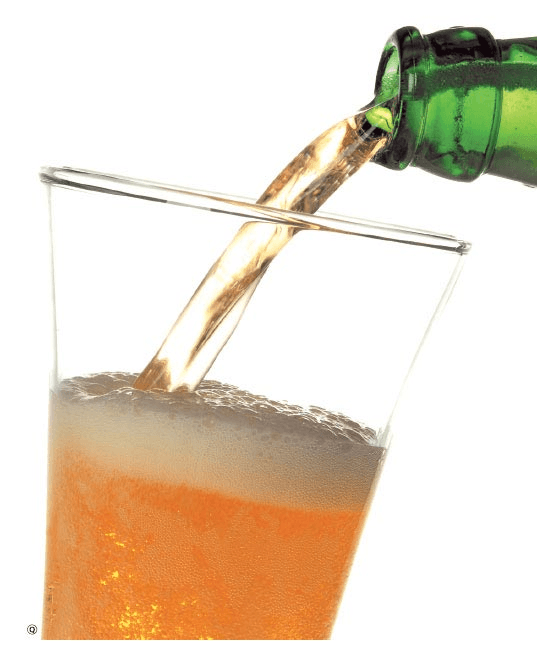
Why does there foam when opening a beer bottle? In the hot summer, many people choose beer to accompany their meals. When beer is opened and poured into a glass, many bubbles will produce inside, forming a delicate foam. If you pour the beer quickly, the foam can easily overflow the mouth of the cup. Why is this?
Beer is rich in foam. In the relevant national standards of China, beer is a kind of "fermented wine containing carbon dioxide, foaming, and low-alcohol content made from malt (including special malt) and water as the main raw materials, adding hops (including hop products), and fermentation through yeast fermentation." Among them, whether the foam is fine and whether it lasts for a long time is a criterion for judging the quality of beer.
Beer is a kind of sparkling wine, and beer in bottles or cans is a supersaturated solution of carbon dioxide. This carbon dioxide is either produced during fermentation or added during filling. Under sealing conditions, the solubility of carbon dioxide in water is related to pressure. The higher the pressure, the more carbon dioxide dissolved. When the bottle is opened, as the pressure becomes less, carbon dioxide will be separated from the beer, forming many bubbles. If the beer is shaken or poured quickly into a cup, or if the surface of the vessel in contact with the beer is rough, more bubbles will be created faster. A similar situation is true for drinks such as cola and champagne that contain a lot of carbon dioxide.
However, bubbles alone are not enough to form a lasting bubble. When cola is poured into a cup, a large number of bubbles will also be produced, but these bubbles will soon break and only small droplets will be splashed out without forming floating foam. There are many organic compounds from malt and other raw materials in beer ingredients. The peptides and proteins contained in them can act as surfactants, making bubbles less likely to break, so it is easier to form a stable foam.
Surfactants are generally organic molecules that have both hydrophilic and hydrophobic portions. Typical surfactants have a hydrophilic polar group in their structure and one or more long "tails" at the other end. These are hydrophobic groups that are easily soluble in non-polar media such as oil (usually longer carbon chains). Phospholipid molecules that make up the cell membrane of organisms, polypeptides and many proteins in organisms can all be used as surfactants. As we all know, you can't make bubbles with clean water, but you can easily blow a large number of bubbles with soapy water. This is because the surfactants in soapy water can stabilize the bubbles.
When beer produces small bubbles, the beer sinks under the gravity of the liquid, and the bubbles come into contact with each other and gather together to form a polyhedral structure: foam. At this time, the hydrophobic "tail" is exposed to the bubbles, while the hydrophilic "head" is stuck in a thin layer of beer, allowing the foam structure to exist stably for a long time.
It can be seen that beer is a supersaturated solution of carbon dioxide, which contains a large number of organic molecules that can be used as surfactants, which is why it can form a large number of bubbles. Coke foam breaks easily