
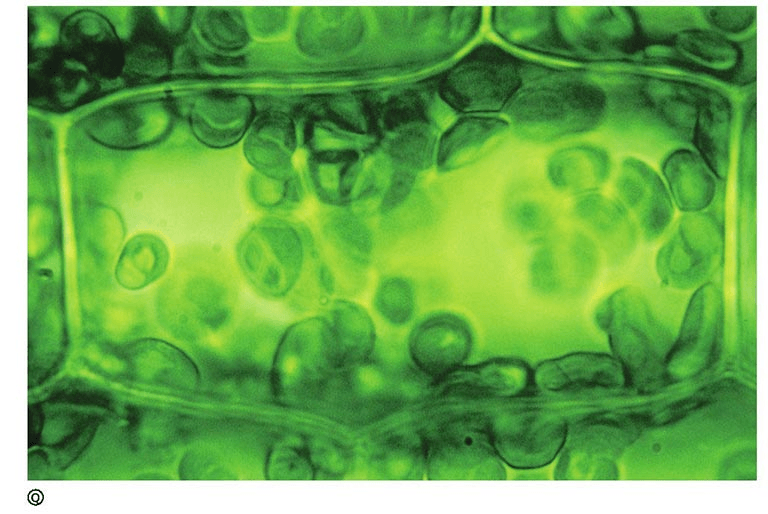
Why can roots send water to treetops? Life cannot be separated from water, and plants are no exception. When you stand under a towering tree, have you ever thought about how it absorbs water from the soil and transports it to every branch and leaf?
Let's do an experiment first. The U-shaped tube contains a glucose aqueous solution, separated by a semi-permeable membrane. The glucose concentration in the right tube is high and the concentration on the left is low. The liquid level on both sides is the same at the beginning. Since only small water molecules can pass through the semipermeable membrane, after a while, the liquid level on the right side will rise and the liquid level on the left will decrease, just like applying pressure to the left side of the pipe and pushing the water pressure to the right side.
A semipermeable membrane experiment with a U-shaped tube. A semipermeable membrane is a membrane that only allows certain small molecules or ions to diffuse in and out, and is selective for the passage of different particles. Cell membranes, bladder membranes, parchment and artificial collodion films are all semi-permeable membranes. The mechanism by which plants absorb water from the soil and transport it to the top branches and leaves is this: Water enters the roots through infiltration from the soil through the semipermeable membrane of the root epidermis, creating a higher osmotic pressure, which, together with other forces in the plant (such as transpiration and capillarity), transports water to the top branches and leaves.
The earliest discoverer of the osmotic pressure phenomenon of plant cells was Nolay of France. In 1748, he wrapped and tied the bottle mouth full of wine with pig bladder and placed it in water. Soon, he discovered that the pig bladder gradually bulged out of the bottle. Finally, the pig bladder burst. He became interested in this phenomenon and conducted research but with no results. In 1877, Van Thoff conducted a study on this and gave a quantitative relationship for osmotic pressure.
There is a semi-permeable membrane (including but not only the cell membrane) on the epidermis of the roots of plants. Water molecules can pass through freely, but mineral ions such as sodium, calcium, and chloride ions and macromolecules such as glucose cannot pass through, so penetration occurs. In plant roots, water penetrates from soil with a high concentration of water molecules into plant cells with a low concentration of water molecules. Dutch physical chemist Van Thoff found that the osmotic pressure generated by some plants can reach several times the standard atmospheric pressure is enough to "pump" water to the tree tops tens of meters high.