
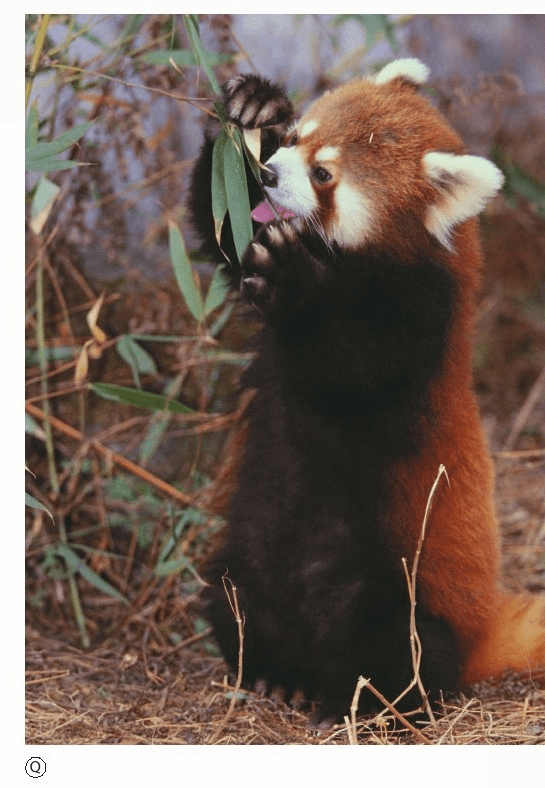
The red panda is not a baby of a giant panda, but another agile small animal. This small animal is 50 - 60 centimeters long and weighs 5 - 6 kilograms. Its coat color is chestnut red. It is also called the red panda. It is also named the Nine-Section Wolf because it has 9 black rings on its tail. They are only distributed in a narrow area in the Himalayas and Hengduan Mountains. There are two subspecies-the Himalayan red panda and the Western Sichuan red panda. The former is distributed in India, Bhutan, Myanmar and Xizang in China. The latter is only distributed in western Sichuan and northwest Yunnan and is endemic to China.
Interestingly, red pandas, like giant pandas, are also animals that mainly eat bamboo. According to statistics, 94% of its diet is bamboo. Not only that, it is also a vegetarian carnivore and still retains the typical characteristics of the digestive tract of a carnivore. Like giant pandas, red pandas occasionally eat meat, hunting some insects, birds, and eggs, and also stealing a few bites of carrion meat. Not only that, the reproductive behaviors of the two species of pandas are also similar, with newborn cubs weighing similar, both ranging from 100 to 250 grams; and neither of them hibernate and can make high-profile "squeaks" and "baa" sounds.
But red pandas are more like cats than giant pandas. They are not only similar in shape, but also have agile climbing capabilities. They are both morning and dusk active animals. Cats get up early in the morning and go to bed late at night, which is mistakenly thought to be nocturnal animals; red pandas are active from dawn and continue until 7 a.m. to 10 a.m.; and start to get excited again from around 5 o'clock in the afternoon. However, they don't stay up late as cats, and will wither again at about 6 o'clock.
Red pandas were once widely distributed in southern China of China. However, as the range of human activities continues to expand, the habitat of red pandas has been squeezed, and the original distribution areas of Shaanxi, Gansu, Qinghai and Guizhou are no longer distributed. Today's red pandas have become a rare animal. It is estimated that thousands of red pandas live in about 37,000 square kilometers of forest in China, close to 1/3 of the world's wild red pandas.