
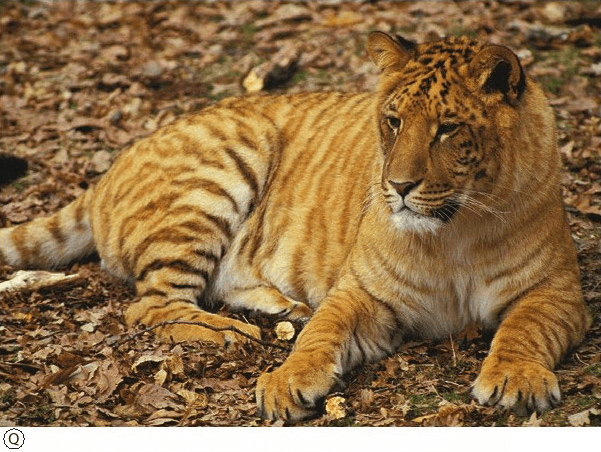
What kind of animal is a liger?
Although tigers live in Asia, and lions were once distributed in Europe and Asia, and there are still subspecies in India today, because these two large animals have basically no intersection in their living environments and are both extremely fierce, they are in the wild. It is unlikely to mate. But in zoos or circuses, lions and tigers are raised together, and too many contact opportunities and relatively docile personalities make it possible for them to mate. Although the success rate of mating is very low, it does produce offspring. What is produced by mating a male lion and a female tiger is called a "liger-beast", and what is produced by mating a male tiger and a female lion-beast is called a "tiger lion".
So, can "liger" or "tiger lion" be regarded as a new species? According to the definition of a species, among other conditions, the most important condition is the ability to produce fertile descendants. If an animal can reproduce from generation to generation, then the species is established; if it cannot reproduce, then it cannot become an independent species. Mules (whether horses and mules born to male donkeys or mares, or donkeys and mules born to male donkeys or female donkeys) are not a biological species because they have no ability to reproduce. There have been no reports of continuous reproduction of "liger" or "tiger lion", so it cannot be regarded as a new species.
In fact, humans have a long history of artificial interspecific hybridization of animals. In the early 20th century, a book devoted to animal interbreeding records was published, which collected interbreeding records of various animals since primates (including humans). Among them, the vast majority of the crosses were unsuccessful, and a considerable number of them had no descendants at all. Although a small number produced descendants, they were either deformed in shape or had abnormal internal development, and most of them died prematurely. Only a very small number of hybrid descendants survived and lived for some time, but no new species was formed.