
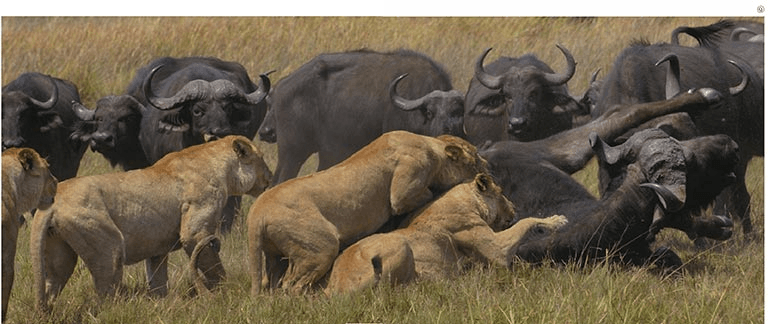
Each species has its own specific lifestyle, including food intake, activity time, cluster or scattered activities, etc. These lifestyles are related to the environment in which the species inhabits, including the physical, chemical and biological environment. It is gradually formed through long-term interaction between animals and the environment and natural selection.
Take lions for example. They live on the vast grasslands of Africa and feed on herbivores zebras, wildebeest, bison, even hippos, giraffes, etc. For these animals, only by running fast can they escape the pursuit of lions. For lions, not being able to outrun these animals means hunger and death. In this case, a few lions have a better chance of winning. It is conceivable that at the beginning, some lions acted alone and some cooperated in hunting. Gradually, individuals who acted alone, often hungry and had no individuals to mate with, were gradually eliminated. Individuals who cooperate in predation have strong reproductive capabilities due to relatively abundant food and sufficient nutrition. Therefore, under long-term evolution and natural selection, the collective hunting habit of lions was gradually formed. Therefore, there is no question of whether you dare to fight one on another, but a matter of death if you don't cooperate. In addition, if the food cannot be eaten for a while, the lions gathered in groups can protect the food from being snatched away by hyenas and others.
There are still many ferocious carnivores who do not choose to fight on. For example, if a wolf wants to deal with a much larger moose, etc., only a group of wolves can round it up; while when a hyena deals with a big creature like a wildebeest, it requires the cooperation of a dozen individuals.