
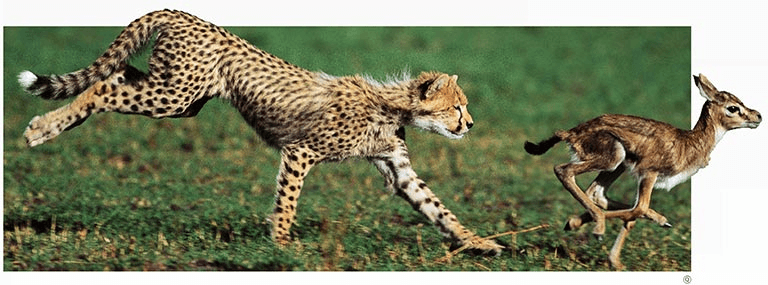
If you have watched some animal documentaries about cheetahs, you will be deeply impressed by the cheetahs 'predation process. We often say that "moving like a rabbit", but in fact, the cheetahs 'movements are the most eye-catching. When it leaps from the grass, spreads its limbs, and pounces at gazelles and other prey like flies, it often makes people feel pity for the petite gazelle.
However, the success rate of cheetahs in predation is not high. As the gazelles move and move, the high-speed cheetahs often give up automatically after chasing for a minute or two, remaining where they are, gasping for breath. Obviously, cheetahs do not have the ability to chase prey at high speed for long periods of time, so why is this?
According to estimates, the starting speed of adult cheetahs is quite fast and can accelerate to 72 kilometers per hour in 2 seconds and reach a maximum speed of more than 110 kilometers per hour. The reason why a cheetah can run so fast is related to its body structure. It has a streamlined body, slender limbs, and a spine that is as soft as a spring and easily flexes. At the same time, its large tail serves as a balance, preventing it from falling during sharp turns.
However, a cheetah that runs so fast not only requires strong support from the skeletal system, muscular system, nervous system, etc., it is a great test to the body's respiratory system and circulatory system, because running at high speed is doing anaerobic exercise. For example, an athlete running 1500 meters cannot sprint with all his strength like an athlete running a 100-meter sprint anyway, because in that case, the respiratory system responsible for inhaling oxygen and exhausting carbon dioxide cannot keep up with the rhythm first. Once oxygen cannot enter the body in time, the circulatory system cannot work, and the cheetah must stop.
At the same time, during high-speed running, the cheetah's body produces a large amount of heat, which must be expelled from the body in time to avoid overheating the body. Sweating and exhaling are both a way to get rid of heat, but not enough to get rid of heat quickly. When heat accumulates in the body, the cheetah will collapse due to overheating, so it must stop at the right time.
Studies have shown that when cheetahs are chasing prey, they can only run at high speed for about 3 minutes at most. Under normal circumstances, it can always resolve the battle in less than 1 minute. If it fails during this period of time, it will make an assessment based on the situation at the time and choose to continue pursuing or give up, rather than blindly exhausting its own physical strength. As a result, only one in six hunting operations will be successful. In this case, choosing to give up can also reserve more strength for the next attack.
The prey captured by the cheetahs through high-speed pursuit is sometimes taken advantage of by more powerful opponents. These bandits are lions or hyenas who are more arrogant than the cheetahs. Since the cheetah was exhausted at this time, in order to protect itself, he could only endure the pain and give up his love. Because once a lion or hyena treats it as a prey, it can only be surrendered without a fight. Who told it that it cannot run at high speed for a long time?