
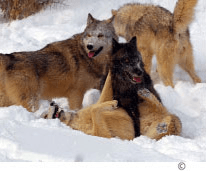
Wolves are a demon in people's minds-ferocious, cruel, and capricious. The idioms such as "wolf-hearted" and "infamous" are either describing its malice or damaging its reputation. People even use "wolf" to describe those ungrateful people. Because of this, since the rise of mankind, the wolf-hunting movement has almost never stopped. About 200 million wolves were killed during the U.S. industrial development alone. At present, the distribution of wolves around the world has shrunk sharply. Because China has encouraged wolf hunting for decades in a row, there are now only some groups in the southwest border. There are fewer wolves, but the problem is here. A typical example appears in Yellowstone National Park in the United States.
Before 1995, wolves in Yellowstone were eliminated to the point where they were almost extinct. Without the wolves, the deer quickly multiplied. The huge number of deer gnawing on trees and grasslands not only caused serious damage to plants, but also caused food shortages for other herbivores. At the same time, more and more deer herds are themselves trapped in hunger and disease. Without the pursuit of wolves, the deer also developed a large number of "wealth diseases", such as obesity, fatty liver, high blood pressure and gallstones. The distortion of the ecosystem prompted Americans to decide to bring the wolf back. In January 1995, 14 wolves came to Yellowstone; a year later, 17 more wolves were shipped here. The arrival of wolves finally brought the deer population under control. Now, the number of deer has dropped from 20,000 to about 10,000. At the same time, forests and grasslands have returned to full vitality, and the population of other grazers has slowly recovered.
In fact, people are full of misunderstandings about wolves. As top consumers in the food chain, they play an important role in maintaining the balance of the ecosystem. Wolves mainly hunt those animals that are old, weak, sick and disabled, which means to eliminate individuals that have affected the healthy development of herbivorous animal groups, while keeping them active while vigilant. Most importantly, they can control the number of herbivores to the greatest extent the environment can bear.
Now, people's views have begun to change. In 1992, several wolves crossed the border from Italy and arrived at Moconto National Park in France, and the French were immediately excited. They sent a working group with the main task of closely monitoring the wolf pack to prevent them from returning to Italy! Many wolf protection organizations have also been formed around the world, all of which are working hard to promote wolf protection. China has also adjusted its original policy of "resolutely eliminating wolves and providing material rewards to those who kill them" to "appropriately control the number of wolves and not arbitrarily catch and hunt." The hard days of wolves being chased and intercepted are about to pass!